Phantom Islands and Hidden Maps: What Governments Don't Want You to Find
Discover the truth behind phantom islands—vanished lands, secret military sites, and map manipulation. Are official charts hiding more than mapping errors? Find out.
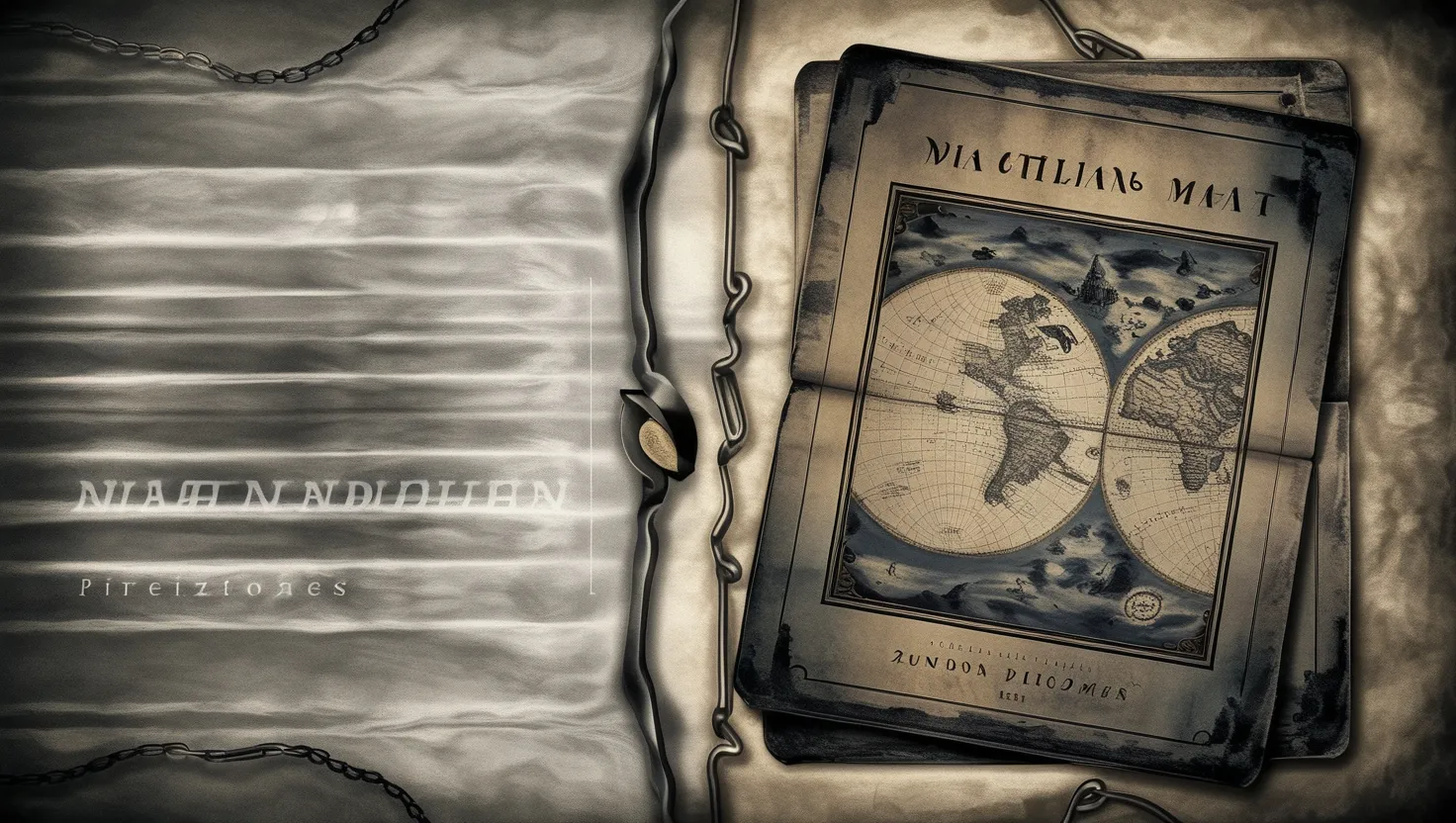
There is something deeply unsettling about the idea that a piece of land can simply disappear. Not sink into the ocean dramatically, not erode over millennia, but just vanish from maps quietly, without ceremony, as if it never existed. This is the world of phantom islands, and once you start paying attention to it, the question stops being “did these places exist?” and becomes something far more uncomfortable: “who decided they shouldn’t?”
Let’s start with the most famous recent example. In 2012, a team of Australian scientists sailed to coordinates in the Coral Sea, between Australia and New Caledonia, to study the area around Sandy Island. The island had appeared on maps for over a century. It showed up on Google Earth. It was listed in scientific databases. When the ship arrived, they found nothing. No sand, no rock, no shallow water. Just 1,400 metres of open ocean. The official story? A mapping error that had been copied and recopied for over 100 years without anyone checking.
Think about that for a moment. A landmass the size of Manhattan had been sitting on official maps, unchallenged, for generations. And the explanation we were given is simply that nobody looked twice.
“Maps are not just representations of territory. They are political documents.” — J.B. Harley, cartographer and historian
The history of phantom islands is longer than most people realise. Medieval and early modern maps are littered with islands that no longer appear on any chart. Hy-Brasil, a circular island said to appear off the coast of Ireland once every seven years, was marked on maps from 1325 until 1865. That’s 540 years of cartographic life for an island that officially does not exist. Saint Brendan’s Island appeared on maps until the 18th century. Antillia, a mysterious rectangular island in the Atlantic, was drawn with such detail and consistency that Columbus reportedly expected to find it on his way to the Americas.
The standard explanation for these is that early sailors had poor navigation tools, confused cloud formations for land, or simply fabricated islands to fill space. But here is what that explanation glosses over: many of these islands were reported independently by sailors from different countries, different centuries, and with no contact with each other. The consistency of their descriptions is harder to dismiss than the experts would like you to believe.
Do you ever wonder why certain patches of the ocean seem suspiciously blurred in satellite imagery? It’s worth spending ten minutes on Google Earth checking coordinates that show up in declassified military documents. You might be surprised.
The military angle is where things get genuinely interesting, and this is the part that mainstream discussion tends to skip past quickly. During World War II and the Cold War, both the United States and the Soviet Union established classified facilities on remote islands that were subsequently removed from publicly available maps. Diego Garcia, a British Indian Ocean Territory island, was scrubbed from many official documents during its transformation into a major US military base in the 1970s. The indigenous Chagossians who lived there were forcibly removed, and for years the island barely registered in civilian consciousness despite being one of the most strategically significant pieces of land on earth.
If a populated island with thousands of residents could be effectively hidden from public consciousness through bureaucratic and cartographic manipulation, what might be possible with a remote, uninhabited patch of rock?
“Whoever controls the image of the territory controls the territory itself.” — Franco Farinelli, geographer
The Cold War created a particularly fertile environment for cartographic deception. Soviet maps, which were only declassified after the fall of the USSR, were deliberately distorted. Cities were moved. Roads were misaligned. Geographic features were intentionally misrepresented to confuse potential invaders. This was not conspiracy theory. This was confirmed, documented state policy. The Soviets had an entire secret mapping agency, the General Staff’s Military Topographic Directorate, that produced accurate internal maps while releasing deliberately false ones to the public and to foreign intelligence services.
If one government was doing this systematically, why would we assume others were not?
The pixelation argument deserves honest attention rather than immediate dismissal. Several locations in Google Earth and other satellite mapping services show either deliberate blurring, artificial cloud cover, or simply missing imagery. Some of these are openly explained as military installations, nuclear facilities, or royal palaces. But some have no explanation attached. When users have attempted to investigate certain coordinates in the Pacific and Indian Oceans, they have encountered nothing but grey boxes or suspiciously uniform white coverage that differs markedly from natural cloud patterns.
Now, could this be a technical artifact of how satellite imagery is stitched together? Absolutely. Could some of it be deliberate? The honest answer is that we have documented precedent for deliberate image manipulation in mapping services at government request. The Netherlands, for example, officially requested blurring of royal palaces and military facilities in Google Maps, and Google complied. The US government has similar agreements in place. The requests are real. The compliance is real. What we don’t know is the full list of what has been requested.
“The map is not the territory.” — Alfred Korzybski
Here is the part of this story that almost nobody talks about: the economic dimension. Phantom islands are not just strategically interesting from a military standpoint. Exclusive Economic Zones under international maritime law extend 200 nautical miles from any land territory. A single small island, if legitimately claimed, gives a nation rights to vast stretches of ocean including everything beneath them. Fish stocks, mineral deposits, potential oil reserves. The incentive to claim, or to suppress the claims of others, runs into billions of dollars.
There are ongoing territorial disputes where the exact status of small rocks and reefs determines which nation controls enormous swathes of resource-rich ocean. In this context, the quiet removal of a geographical feature from official charts is not just a historical quirk. It is a tool of economic policy.
Ask yourself this: if a government discovered an uninhabited island in a strategically or economically significant location, would they announce it immediately? Or would they quietly assess what they had first?
The Bouvet Island situation offers a strange footnote to all of this. Bouvet is officially the most remote island on earth, a Norwegian territory in the South Atlantic. In 1964, a British expedition found an abandoned lifeboat and camp on the island with no explanation of who left it or why. No missing ships were reported. No expedition was ever claimed. The mystery was never solved, and official interest in solving it appeared to be minimal. The incident is real, documented, and genuinely unexplained.
Strange things happen in remote ocean territories. The difference between a conspiracy theory and a documented fact is often just time and the right freedom of information request.
“We are all cartographers of our own ignorance.” — Rebecca Solnit
What I find most compelling about the phantom island phenomenon is not the specific claims, some of which are clearly the product of overactive imaginations meeting ambiguous satellite data. What strikes me is the structural argument. We know maps have been falsified. We know islands have been militarised and hidden from public knowledge. We know governments request the blurring of sensitive locations in commercial mapping products. We know maritime law creates enormous financial incentive to control geographic information. All of these are facts, not theories.
The leap from documented fact to conspiracy is smaller than it looks. The phantom island theory does not require you to believe in elaborate secret societies or impossible logistics. It only requires you to believe that governments, which have done exactly this kind of thing before, might continue doing it when the stakes are high enough.
The question worth sitting with is not whether Sandy Island was a mistake. Maybe it was. The question is what we would expect to find if we looked seriously at the coordinates we are quietly never encouraged to look at, and whether the maps we trust to show us the world are showing us all of it.