Wow Signal Mystery: 72 Seconds That Changed SETI Research Forever
Discover the Wow! Signal mystery: a 72-second radio burst from 1977 that captivated scientists. Explore alien theories, military secrets & cosmic explanations. Read more!
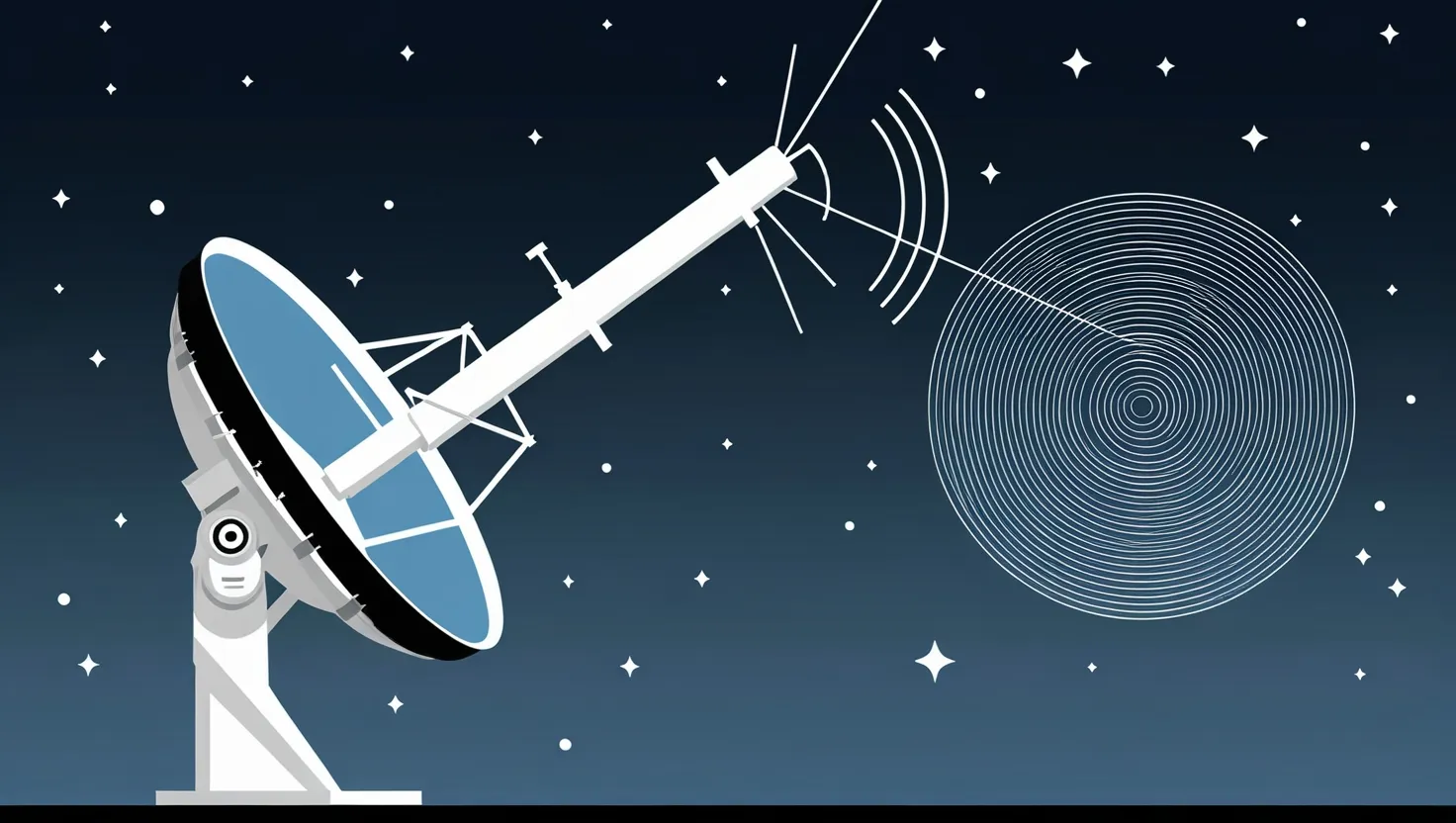
On a warm night in 1977, something extraordinary happened at Ohio State University’s Big Ear radio telescope. A burst of radio energy arrived—so sharp, so clean, and so unlike the rest of the cosmos’ background hum that astronomer Jerry Ehman marked the printout with a single scrawled word: Wow! That one word is the heartbeat of an ongoing scientific debate and a symbol of humanity’s search for meaning in the vast emptiness.
What makes the Wow! Signal so captivating even after almost fifty years? At first glance, it lines up with everything you’d expect if another civilization wanted to get noticed. It’s narrowband—meaning it appeared only at a very specific frequency, about 1420 MHz—that isn’t just any number. This is the frequency of neutral hydrogen, the most abundant element in the universe. It’s where thoughtful scientists believe any cosmic hello would be most likely to appear, since the “hydrogen line” is seen as a universal radio marker known to anyone with some astrophysics under their belt.
“If you wish to make an apple pie from scratch, you must first invent the universe.” — Carl Sagan
But the signal was there for only 72 seconds, then vanished. Never once since, despite thousands of hours of follow-up, has anything similar been detected from exactly the same patch of sky. That fleeting nature is at the core of the mystery. Natural signals repeat, drift, or roar in static bands, but the Wow! Signal was like a shout in a cathedral that echoes only once.
So, was this a whisper from another world? It’s tempting. But history tells us that nature is the greatest trickster of all. Short-lived cosmic phenomena, bizarre neutron stars, black hole mergers—these all generate brief flashes the likes of which we are just starting to catalog. Several recent papers make a strong case that the source might be a rare hydrogen maser flare or the sudden brightening from an exploding magnetar—a type of neutron star. Astrophysical events like these can produce bright, transient signals, but the odds of one lining up perfectly with our telescope at that precise frequency are long. Still, it’s possible we caught nature mid-prank, showing off a behavior we had never seen before.
Now let’s entertain a different idea. Could this be something closer to home? During the Cold War, the military launched clusters of secret satellites designed to sniff out foreign ships and subs. Known as the Naval Ocean Surveillance System (NOSS), these satellites emitted radio signals—including at frequencies tantalizingly close to the hydrogen line. Declassified orbits even show these satellites could have been in the sky above Big Ear at the key moment. But there’s a snag: official records, both military and civilian, do not confirm any kind of scheduled test that night. If it was a military echo, the secrecy must be deeper than the declassified files admit.
Have you ever wondered just how much radio noise we’re surrounded by every day? Try switching on an old AM radio and turning the dial. Some of those pops and whistles are from thunderstorms in another country, but others are your neighbor’s microwave or a passing plane’s radio. Big Ear was built to filter out most of this terrestrial chatter, but the possibility lingers: could a signal have bounced off high-flying hardware—known or unknown—landing perfectly at the hydrogen line for just a breath of time? Some engineers and physicists suspect so, though the details—especially the spectral purity and strength—remain incredibly hard to explain.
“The universe is under no obligation to make sense to you.” — Neil deGrasse Tyson
Suppose for a minute that the origin is genuinely cosmic. Why would an intelligent alien civilization send a single, finely tuned burst, never to repeat it? Wouldn’t persistence be more logical, or at least a series of pings to confirm receipt? This has sparked speculation about so-called “beacons” that flash only once every long cycle, maybe to conserve energy or act as a cosmic lighthouse with a slow spin. Or perhaps, the civilization, if real, succumbed to its own extinction before ever repeating the call.
Curiously, some scientists propose the briefness isn’t a bug, but a feature. Imagine a civilization using focused power beaming to propel spacecraft—think giant lasers or microwaves pushing starships. If Earth simply drifted through the thin edge of a tightly aimed beam, for just a moment, we might have picked up what looks like an artificial signal without it being directed at us at all. This idea is compelling for its simplicity but distressing for its implications—it would make such detections random, rare, and likely never repeated.
If you were programming a telescope’s search algorithms today, how would you decide what’s truly alien and what’s plain noise? Advances in machine learning and thousands of hours of digital “ear” time haven’t spotted another Wow! Signal, but they’ve caught plenty of “candidate” blips that turn out, on closer inspection, to be interference or cosmic coincidence. The more sensitive our instruments grow, the more crowded the skies feel—not with new life, but with static from our own machines.
“Somewhere, something incredible is waiting to be known.” — Carl Sagan
Others have argued the Wow! Signal could be tied to cometary hydrogen clouds—vast, faint streams of matter left by passing comets. But check the star maps: the suspects suggested as possible sources simply weren’t in view that night, and the way comets radiate energy doesn’t match the sharp, focused spike Big Ear received.
Questions linger. If a military program was responsible, why has no official ever admitted it, even after classified materials surfaced? Conversely, why would a cosmic event produce such a perfect signal and then vanish forever? In science, singular events are always suspect—not because they can’t be real, but because extraordinary claims demand extraordinary evidence.
Would you bet the next century’s search efforts on the hope that a signal like Wow! will reappear, or should we focus on a new method altogether? The next generation of instruments—like South Africa’s MeerKAT and other arrays—now scans wider, listening for any twitch in the fabric of radio space. Machine learning, fed with petabytes of cosmic noise, waits for a glitch with the right signature.
Yet, it’s precisely the unresolved, twilight zone status of the Wow! Signal that keeps our eyes on the skies. Some see it as a mirror for our own curiosity, a sign that the universe is wider and stranger than our current knowledge. For every technological limitation we conquer, a new riddle emerges.
I sometimes picture Jerry Ehman marking the printout, pausing to reflect on what he had just found. Was this a random artifact—a trick of light, data, and circumstance? Or did that 72-second burst truly carry information from beyond? If so, what story was told in six letters and numbers—6EQUJ5—a code that arguably says more about our hunger for contact than anything else.
Do you think our own signals might already be racing out to whisper wow moments to distant worlds circling other stars? Or is our cosmic eavesdropping still too clumsy for such an encounter?
Questions like these are the real legacy of the Wow! Signal. They aren’t about answers so much as an attitude—a resolve to keep listening, keep asking, and keep interpreting the smallest anomalies for what might lie behind them. Whether artifact, accident, or announcement, the Wow! Signal is a monument not to alien contact, but to scientific wonder—and the honesty to say, even decades later, “we still don’t know, but we’re eager to find out.”