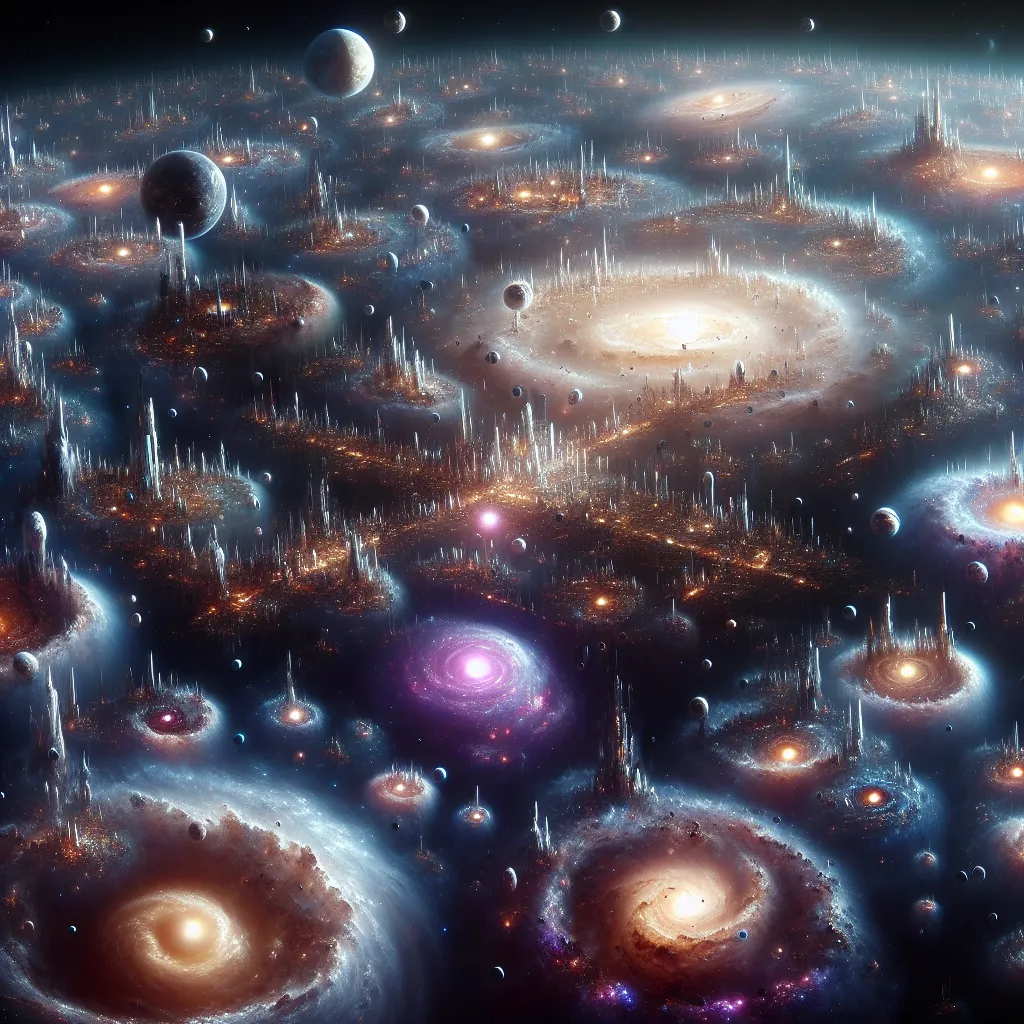
Imagine if there were thousands of alien empires scattered across the Milky Way, each controlling a few star systems. They might trade, chat, or even have occasional skirmishes. But the big question is, why hasn’t anyone visited us? Given the age and size of the Milky Way, even at 10% the speed of light, an advanced civilization could colonize the galaxy in a million years. Yet, we’ve seen no evidence of this, making it seem like we’re alone.
However, this assumption might be wrong. Scientists often expect technological progress to make space colonization easy. What if even advanced aliens find space travel incredibly tough? Let’s look at ourselves for a clue.
Think of the Milky Way like Oceania, a vast region with thousands of islands spread across a deadly ocean. The Polynesians, in ancient times, bravely set out to colonize these islands with minimal technology. The Pacific islands varied - some were barely habitable, others were uninhabited due to harsh conditions, and just a few were perfect for settlement.
The Polynesians built impressive cultures on the good islands, with some forming kingdoms and others remaining independent but connected through trade and exchange. Nevertheless, even the best islands could be abandoned; just like the isolated Pitcairn islands, which were settled for centuries before their population vanished.
Now, consider space as an ocean. Even if aliens expanded like Polynesians, they might ignore the bad planets and pick only the best ones. In the Milky Way, there could be around 200 billion star systems with numerous Earth-like planets in habitable zones. But most of these planets are inhospitable, like Mars or Venus, where survival and terraforming would be nearly impossible without immense resources.
Imagine traveling for centuries to a new star, just to find a planet like Mars. Terraforming would require so much effort that it might not be worth the trip. Even high-tech civilizations might struggle, making galaxy-spanning empires less likely due to economic constraints. If spreading across stars were easy, someone would have done it by now.
What if aliens only colonized the best planets, creating small, connected star systems? These empires might interact, trade, or even fight. But maintaining a large, consistent civilization would be tough due to the vast distances. Also, cultural and biological evolution could make different colonies diverge into unique species, reducing the chances of a unified galaxy.
Thus, there might be many small, temporary galaxies with civilizations that rise and fall. Some planets might be abandoned and recolonized repeatedly.
For us, this scenario means we could be on an isolated island in the cosmic ocean. We might be unaware of other civilizations because they’re too far away or uninterested in us. Perhaps, in the future, we’ll drift closer to other “islands” and discover a whole new world of neighbors. Until then, we’ll keep exploring our universe, hoping to find our place in it.
Thinking about our cosmic loneliness can be both exciting and daunting. As we learn more, we might find that we’re not as alone as we thought—or that we’re in a unique position to get our act together before meeting others. So next time you look up at the stars, ponder our place in this vast universe.