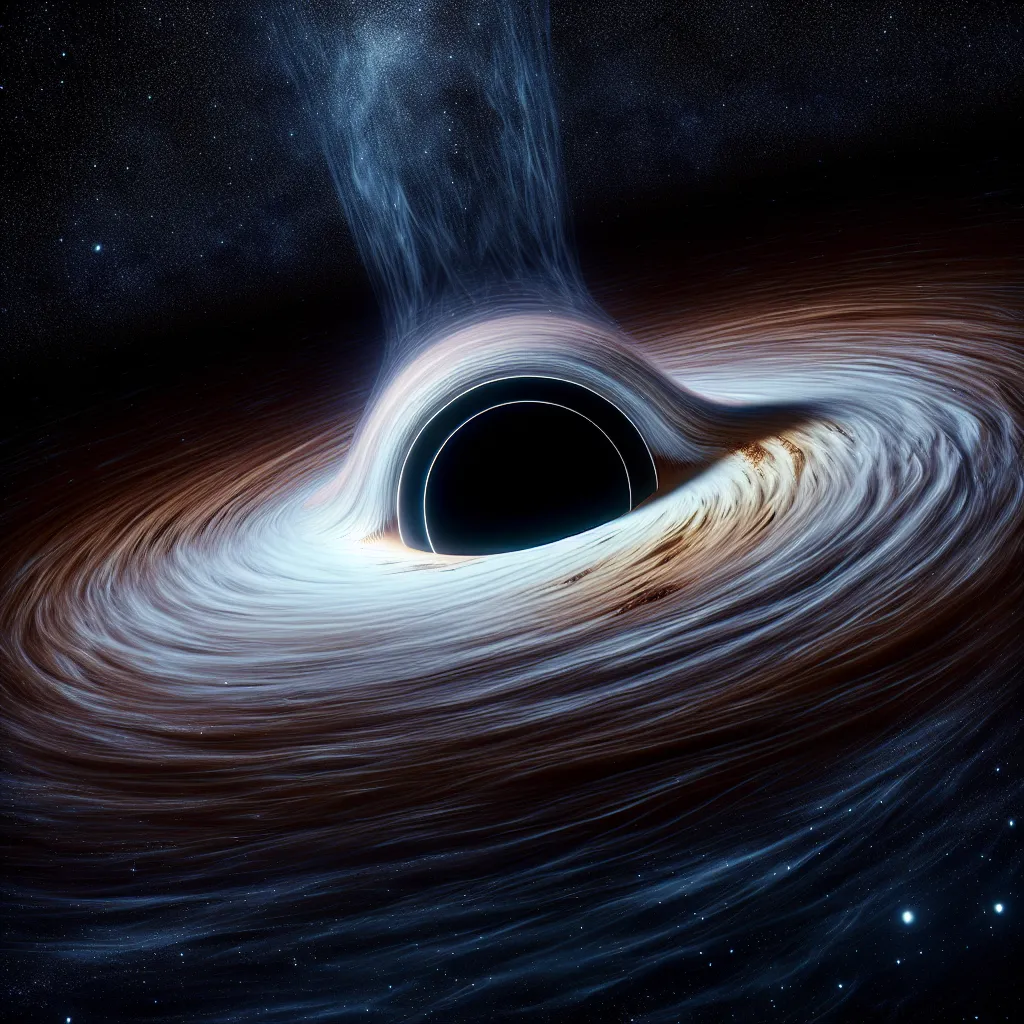
Black holes are the universe’s most formidable forces, capable of tearing entire stars into minuscule pieces. That alone is pretty terrifying, but they have an even darker capability: they might have the power to delete the universe itself.
Let’s start by understanding black holes. A black hole forms when a massive amount of matter packs into a tiny space. At their core, gravity is nearly infinite, and anything that gets too close gets shredded into its basic particles. Even light can’t escape black holes, which is why they appear as black spheres.
If you fall into a black hole, initially, nothing alarming happens. Imagine drifting in a river that rushes toward a massive waterfall. At first, you can swim to safety, but eventually, the current quickens, and without realizing it, you’ve crossed the point of no return. No matter how hard you try, you can’t escape the black hole’s pull—you’re drawn in, never to return. This border, the event horizon, separates black holes from the rest of the universe, making them inaccessible.
However, black holes aren’t entirely closed off. They emit Hawking radiation, losing an incredibly tiny portion of their mass over time. This process is excruciatingly slow—it would take a black hole with the mass of our sun billions upon billions of years to lose even a negligible amount. Eventually, though, black holes will shrink and disappear, leaving behind faint radiation. But in doing so, they pose a problem: they might destroy information.
Information isn’t something you can touch. It’s about how particles are arranged. For instance, organize carbon atoms one way, and you get coal; arrange them differently, and you get a diamond. Information is the difference between everything in the universe. According to quantum mechanics, information can change form but can never be destroyed.
If you burn a piece of paper, you’ll have ash—but if you could painstakingly gather all the carbon atoms and measure the smoke and heat, theoretically, you could reconstruct the paper. The information is still there; it’s just difficult to decipher. Thus, if we could measure everything in the universe, we could track all information back to the Big Bang. But black holes challenge this idea by seemingly destroying information.
This is the information paradox. It’s a massive issue because our physical laws hinge on the idea that information is never lost. There are a few theories about how to resolve this. One is that information truly does get lost, but this would mean overhauling the very foundation of physics. Another is that information might hide in a “baby universe” or in some remnant after the black hole evaporates, though we’d never be able to access it.
There’s a third possibility: the information might be encoded on the black hole’s surface through the holographic principle. If true, what falls into a black hole is stored on its event horizon in a manner similar to how a flat surface can encode three-dimensional data, similar to a hologram. Hawking radiation might even learn and carry away this encoded information, suggesting that no data is truly lost.
If this duality between 2D and 3D works for black holes, it might apply to the entire universe, meaning our reality could be a kind of hologram. This idea is complex and involves sophisticated theories and mathematics, but it points to black holes being crucial in understanding the very nature of existence. This revelation, while mind-bending, requires us to rethink our understanding of the universe and continue delving deep into physics for answers.