In 1908, President Teddy Roosevelt aimed to ban all timber and mining operations in the Grand Canyon. However, it wasn’t until 11 years later that Congress declared the area a national park. Before the restrictions set in, explorer GE Kincaid saw a window of opportunity and decided to journey down the Colorado River through the Grand Canyon, eager to discover what treasures might still be unearthed.
Around 40 miles upriver from the El Tovar Crystal Canyon, Kincaid noticed unusual stains on a rock wall about 2,000 feet high. Intrigued, he docked his boat and set off to investigate. After trekking through desert brush, he stumbled upon carved sandstone steps, clearly man-made. These steps led to a cavern entrance and, to Kincaid’s astonishment, inside the cavern, he found ancient Egyptian Hieroglyphics etched on the walls.
Equipped with a flashlight and his trusty pistol, Kincaid ventured deeper into the tunnel, meticulously noting down his findings. The main passageway was about 12 feet wide, eventually narrowing to nine feet. Side passages branched off, leading to various rooms varying in size, some resembling modern-day living rooms. These rooms were filled with ancient artifacts, including shelves of glazed pottery and even remnants of seeds and cooking tools. Kincaid realized he was in an ancient, extensive complex.
One particularly striking discovery was a room dedicated to metalwork, hinting at a form of technology that shouldn’t have existed in this area. Copper tools were abundant, suggesting the knowledge of hardening this metal—a lost art sought by chemists for centuries.
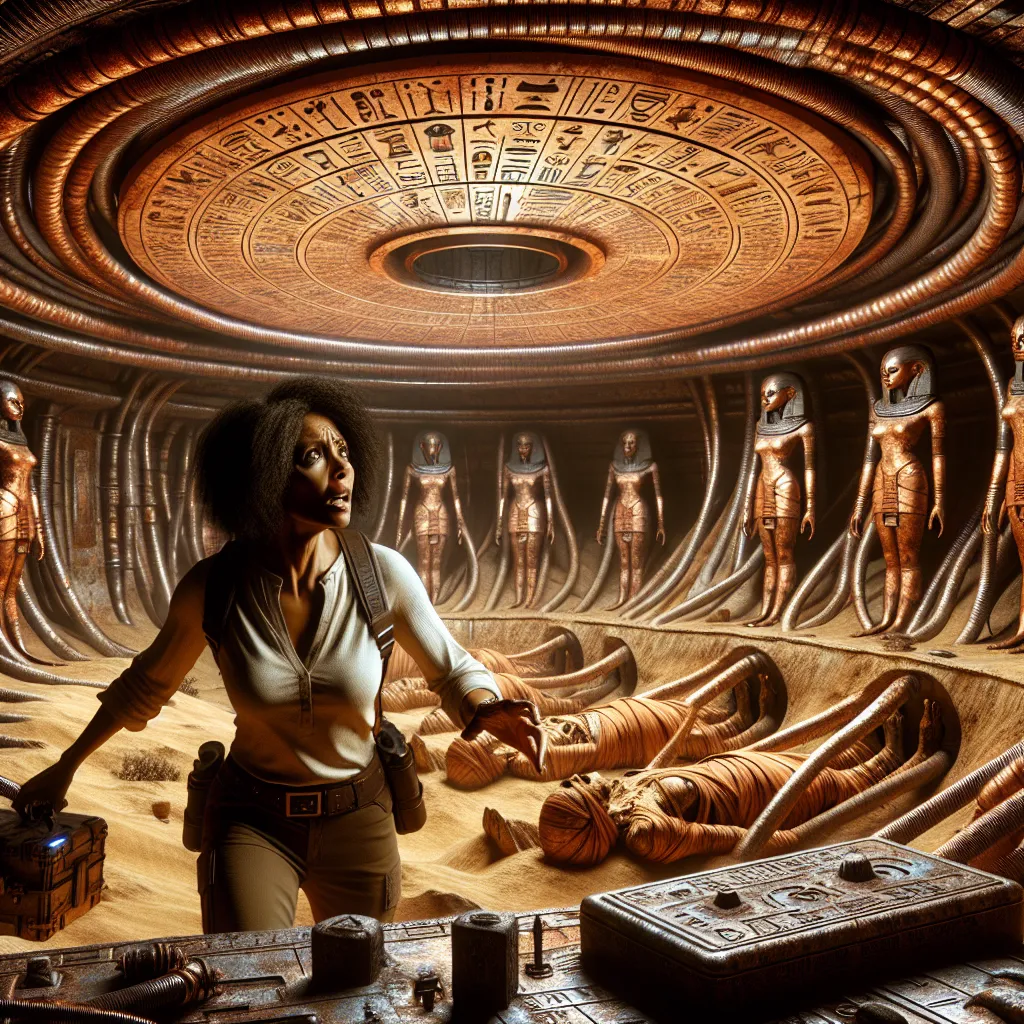
Exploring further, Kincaid found a crypt filled with rows of mummies, each occupying individual shelves with copper cups and broken swords beside them. Observations suggested this room might have been a warriors’ barrack due to the absence of women and children.
Realizing the enormity of his discovery, Kincaid sent artifacts and detailed notes to the Smithsonian, requesting support. The Smithsonian responded by dispatching Professor SA Jordan and a team of researchers to excavate and learn more. They named the site “The Citadel” and discovered a large statue resembling Buddha at the central chamber of the intricate cave system.
Despite their exhaustive research, the origin of this advanced civilization remained elusive. Although they found swords, shields, pottery, and tablets inscribed with hieroglyphs, experts couldn’t identify the civilization definitively. However, they agreed on two fundamental points: the civilization was highly advanced and didn’t originate locally in the Grand Canyon, hinting at influences from Egypt or Asia.
Kincaid and Professor Jordan’s work suggested these ancient people were technologically advanced, skilled, and spiritually complex, migrating from distant lands. However, their pursuit for more resources to continue research hit a wall, and their requests were ultimately denied, leaving many questions unanswered.
The Grand Canyon, beyond its natural splendor, holds deeper cultural and spiritual significance. The Hopi, Navajo, and other tribes consider it sacred, with legends about ancient beings and civilizations rooted in the region’s lore. Some tales even speak of reptilian races and giants, suggesting that the area was significant long before its discovery by modern sciences.
David Hatcher Childress, a renowned author, posited that the Smithsonian might be actively hiding evidence of ancient advanced civilizations. He cited various discoveries of tall skeletons and complex mound structures across North America that mysteriously disappeared after Smithsonian involvement.
Many believe in a grand cover-up to suppress findings that challenge existing historical narratives. Evidence of pre-Columbian trans-oceanic contact would rewrite history, showing that advanced civilizations once thrived independently in North America.
While mainstream researchers dismiss these stories as hoaxes, others relentlessly pursue the truth. Explorers like Jerry Wills, who dedicated years to finding the Kincaid cave, faced federal restrictions and mysterious deterrents. Despite potential dangers and official declarations of hoaxes, the allure of uncovering hidden histories keeps the quest alive.
The Grand Canyon’s legends, treasures, and untapped mysteries continue to inspire and provoke curiosity. Perhaps, one day, the undisputed truth about these ancient, possibly global civilizations will surface, reshaping our understanding of history and human civilization.