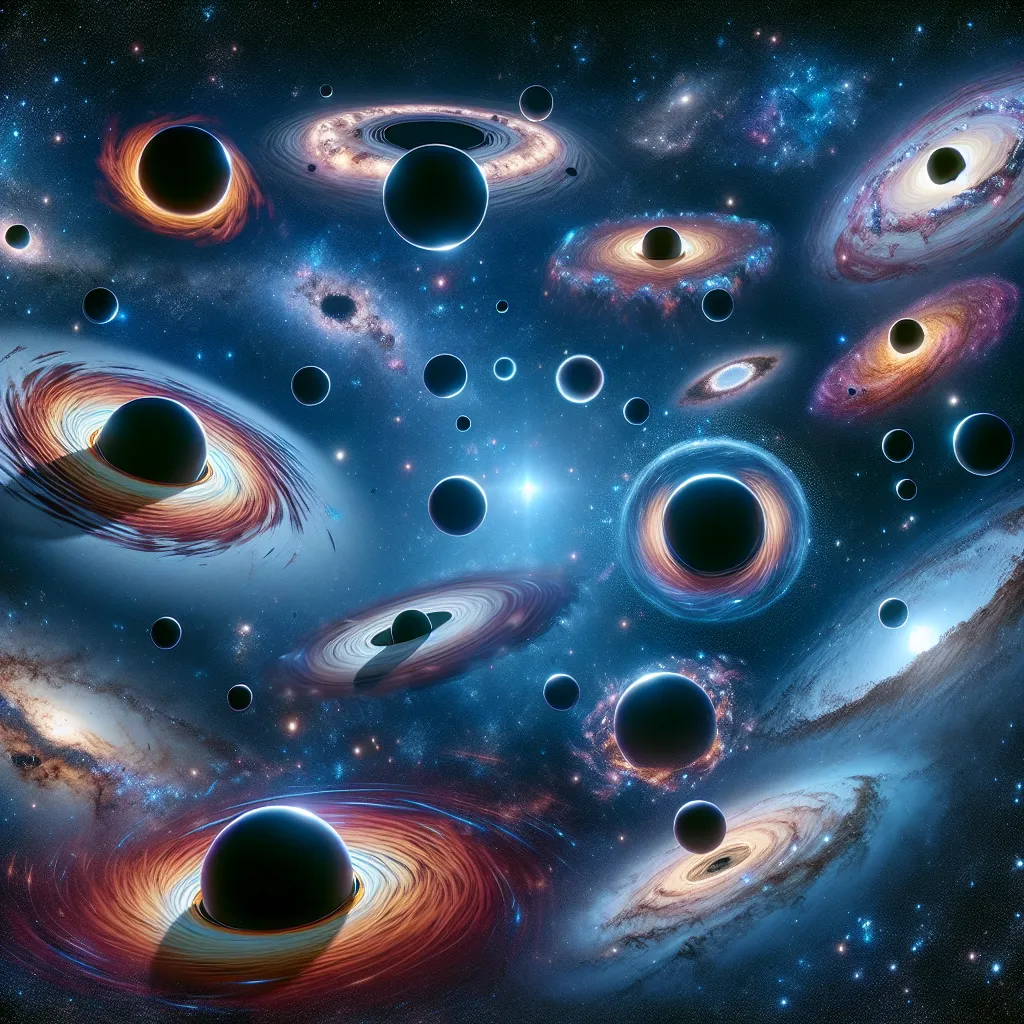
Black holes are the titans of the universe, boasting sizes that put planets and stars to shame. These cosmic giants don’t have a physical size limit and can grow infinitely. However, different processes create black holes, ranging from minuscule to gargantuan. Let’s delve into how black holes grow and discover the largest of them.
Starting small, primordial black holes might be the oldest objects in the universe, possibly forming right after the Big Bang. These black holes could be as small as a proton but with the mass of a mountain. Despite their weight, they’re tough to find and could even be the mysterious dark matter holding galaxies together.
Next, we have stellar black holes. They form when massive stars collapse or during the merging of neutron stars. The smallest known stellar black hole is about 2.7 times the mass of our Sun, while giants like M33 X-7 have grown by devouring nearby stars. These stellar black holes can be just kilometers wide but with enough mass to dominate their region.
To grow even larger, black holes need to merge with others or consume an extraordinary amount of matter. Merging black holes have been observed, like a pair that combined to create a black hole about the size of Germany with 142 solar masses. But here’s where it gets interesting: there’s a gap between black holes up to 150 solar masses and those in the millions.
Supermassive black holes, found at the centers of most galaxies, might have started as quasi stars, immense stars from the early universe that collapsed into supermassive seeds while still growing. These seeds could eventually become today’s enormous black holes, like Sagittarius A Star in our Milky Way with around 4 million solar masses.
Supermassive black holes affect their galaxies immensely. They don’t hold galaxies together—the unseen dark matter does—but their gravitational influence is massive. Some, like the black hole in BL Lacertae galaxy, are so active they produce jets of plasma nearly reaching light speed.
When we talk about the most massive black holes, we enter the realm of ultramassive black holes. These giants, like the one in OJ 287 with 18 billion solar masses, dwarf even other supermassive black holes. And the king of them all is TON 618, boasting 66 billion solar masses. It shines with the intensity of a hundred trillion stars and is so vast light takes a week to cross it.
Understanding black holes is complex, and our data has limitations. We infer much about black holes from their gravitational effects, often treating them as idealized spherical objects. This introduces uncertainties, so our knowledge continues to evolve.
Black holes remain some of the universe’s most fascinating and mysterious entities. From nearly invisible primordial ones to the monstrous TON 618, black holes are here to stay, growing and shaping the cosmos long after other celestial bodies fade away.