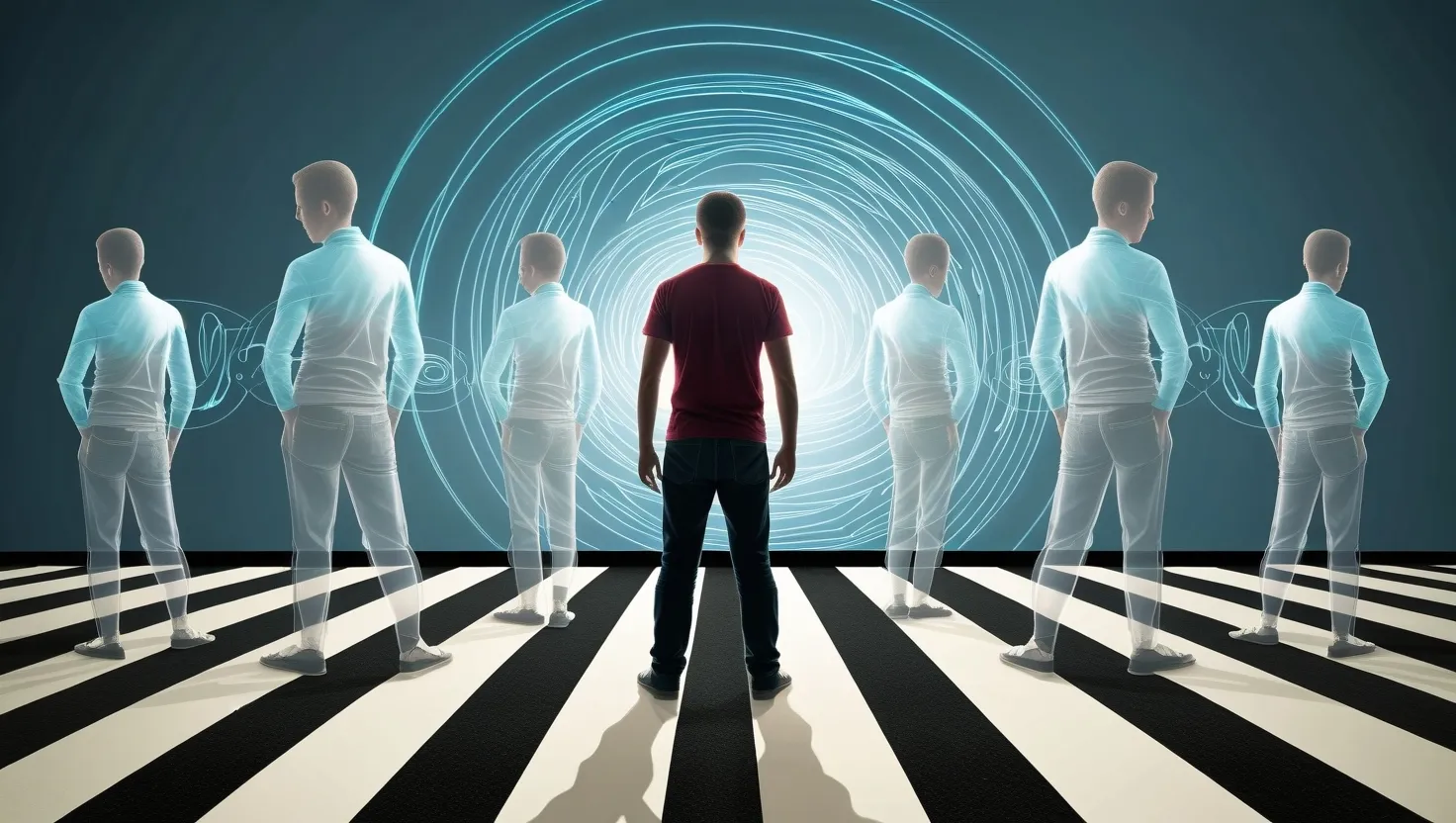
Imagine a world where every decision you make creates a new reality, and in each of these realities, there is a version of you living a different life. This concept, rooted in the many-worlds interpretation of quantum mechanics, suggests that every possibility branches out into a separate universe. But what if these parallel versions of yourself are not just passive alternatives, but are actually influencing your decisions and experiences in subtle, yet profound ways?
This idea, often referred to as the “quantum doppelgänger paradox,” proposes that quantum entanglement could facilitate a kind of communication or influence between these parallel selves. Entanglement, a phenomenon where particles become connected in such a way that the state of one particle is instantly affected by the state of the other, regardless of the distance between them, is a well-documented aspect of quantum physics. However, extending this concept to human consciousness and decision-making is a far more speculative and intriguing idea.
Let’s delve into the possibility that these alternate versions of you might be the source of those inexplicable hunches or sudden changes of heart that we all experience from time to time. Imagine you are at a crossroads, torn between two career paths. One version of you in a parallel universe might have chosen the path you are hesitant about, and through some form of quantum bleed-through, you are receiving subtle cues or intuitions that are guiding your decision.
This theory is not just about random influences; it suggests a deeper, more interconnected web of consciousness that transcends our conventional understanding of space and time. For instance, the concept of “spooky action at a distance,” a term coined by Einstein to describe the instantaneous effects of entanglement, could be seen as a mechanism through which parallel selves communicate.
Researchers have explored similar ideas through experiments involving quantum entanglement and superposition. In one notable experiment, scientists at Yale University created an entangled system where two subatomic particles were connected in such a way that any change in one particle instantly affected the other, regardless of the distance between them. This experiment was likened to Schrödinger’s cat, where the cat can be both dead and alive until observed, but here, the particles existed in two states simultaneously and could influence each other across vast distances.
If we apply this principle to human consciousness, it raises fascinating questions about free will and decision-making. Are our choices truly our own, or are they influenced by the cumulative experiences of our parallel selves? This idea challenges the traditional view of free will, suggesting that our decisions might be part of a larger, interconnected process that spans multiple realities.
The twin paradox, a thought experiment in special relativity, also offers some insights into this concept. In the twin paradox, one twin travels at relativistic speeds while the other remains on Earth, resulting in different aging rates due to time dilation. However, if we introduce quantum mechanics into this scenario, as some researchers have done, we get a quantum-mechanical variant where the traveling twin can exist in two paths simultaneously due to superposition. This superposition could be seen as a form of communication between different versions of the twin, each living a different reality.
But how can we tap into this supposed connection with our parallel selves? The answer might lie in understanding the nature of quantum entanglement and how it applies to consciousness. Some theories suggest that our brains could be entangled with our parallel selves, allowing for a form of quantum communication that transcends classical physics.
For example, consider the phenomenon of déjà vu – that feeling of having experienced a situation before, even if you know you haven’t. Could this be a glimpse into a parallel reality where a version of you has already lived through the same moment? Or perhaps it’s a form of quantum feedback, where your parallel self is influencing your current experience.
The implications of this theory are vast and mind-bending. If we can consciously tap into the knowledge and experiences of our parallel selves, it could revolutionize how we approach decision-making and problem-solving. Imagine being able to draw upon the collective wisdom of countless versions of yourself, each having navigated different paths and encountered different challenges.
However, this idea also raises ethical and philosophical questions. If our decisions are influenced by our parallel selves, do we truly have free will? Or are we part of a larger, deterministic process that spans multiple realities? The answer to these questions could fundamentally change how we understand ourselves and our place in the universe.
In conclusion, the quantum doppelgänger paradox is a fascinating blend of quantum physics, psychology, and multiverse theory that challenges our conventional understanding of reality and decision-making. While it remains a speculative idea, it opens up new avenues for exploring the nature of consciousness and the interconnectedness of our universe. So the next time you feel that inexplicable hunch or sudden change of heart, you might wonder – is it just your intuition, or is it a message from a parallel version of yourself, guiding you through the complexities of life?