The Bloop Mystery: How Scientists Decoded the Ocean's Most Powerful Unknown Sound
Discover the mysterious 1997 Bloop sound that traveled 5,000km underwater, baffling scientists worldwide. Learn the fascinating truth behind this oceanic phenomenon and why it captivated researchers for decades.
The Bloop: When the Ocean Spoke and Science Listened
In 1997, something remarkable happened in the South Pacific Ocean that would perplex scientists and capture public imagination for decades to come. A sound so powerful, so strange, and so loud that it traveled over 5,000 kilometers underwater through multiple hydrophone sensors.[1][2] This wasn’t the rumble of an earthquake or the hiss of a submarine. This was something different. Something that didn’t fit neatly into any existing category. We call it the Bloop, and to this day, it remains one of the most talked-about acoustic mysteries in modern science.
Let me paint the picture for you. Imagine you’re listening to the ocean through underwater microphones scattered across the Pacific. For most of the time, you hear the expected sounds—whale calls, ship engines, the occasional crackle of ice. Then, in the summer of 1997, something cuts through the usual background noise. A low-frequency sound emerges, rises in pitch for about sixty seconds, then vanishes forever. It was so loud that sensors separated by thousands of kilometers all picked it up simultaneously.[2] The equipment that detected it was specifically designed to catch nuclear explosions and underground earthquakes. Yet this was neither. Here’s a question for you: what could make a noise so powerful that it echoes across an ocean basin?
The initial mystery was real. Scientists weren’t sure what they were looking at. The sound had characteristics that seemed almost biological—it had a pattern, a rhythm, a quality that resembled living creatures. Some researchers wondered if we had finally detected an unknown giant creature, something so massive that it had eluded human detection until now.[2] The public imagination ran wild. Could this be a sea monster? Could there be creatures so enormous that they made the largest whales look small? Movies were made, documentaries produced, and conspiracy theories flourished. The idea was intoxicating because it suggested that the ocean—a place we thought we understood—still held genuine surprises.
But here’s where the story gets more complicated and, honestly, more interesting.
When I think about how science works, I think about this moment. A sound shows up. It doesn’t match existing theories. So scientists do what they always do—they gather more data, they test hypotheses, and they look for patterns. The Bloop was detected near a remote location at 50°S 100°W, in an area of the South Pacific west of South America.[1][2] The region wasn’t random. It was close to areas known for intense glacial activity, particularly near the Antarctic glaciers. This geographical fact would become crucial.
Researchers began deploying additional hydrophones near Antarctica and the Pacific Ocean specifically to study this phenomenon and similar sounds.[1] They used spectrograms—basically visual representations of sound waves—to analyze the Bloop’s frequency patterns over time. They compared it to every other sound previously recorded in the ocean. They looked for matches, for explanations, for something that made sense. One particular theory began gaining strength: ice quakes.[1][2]
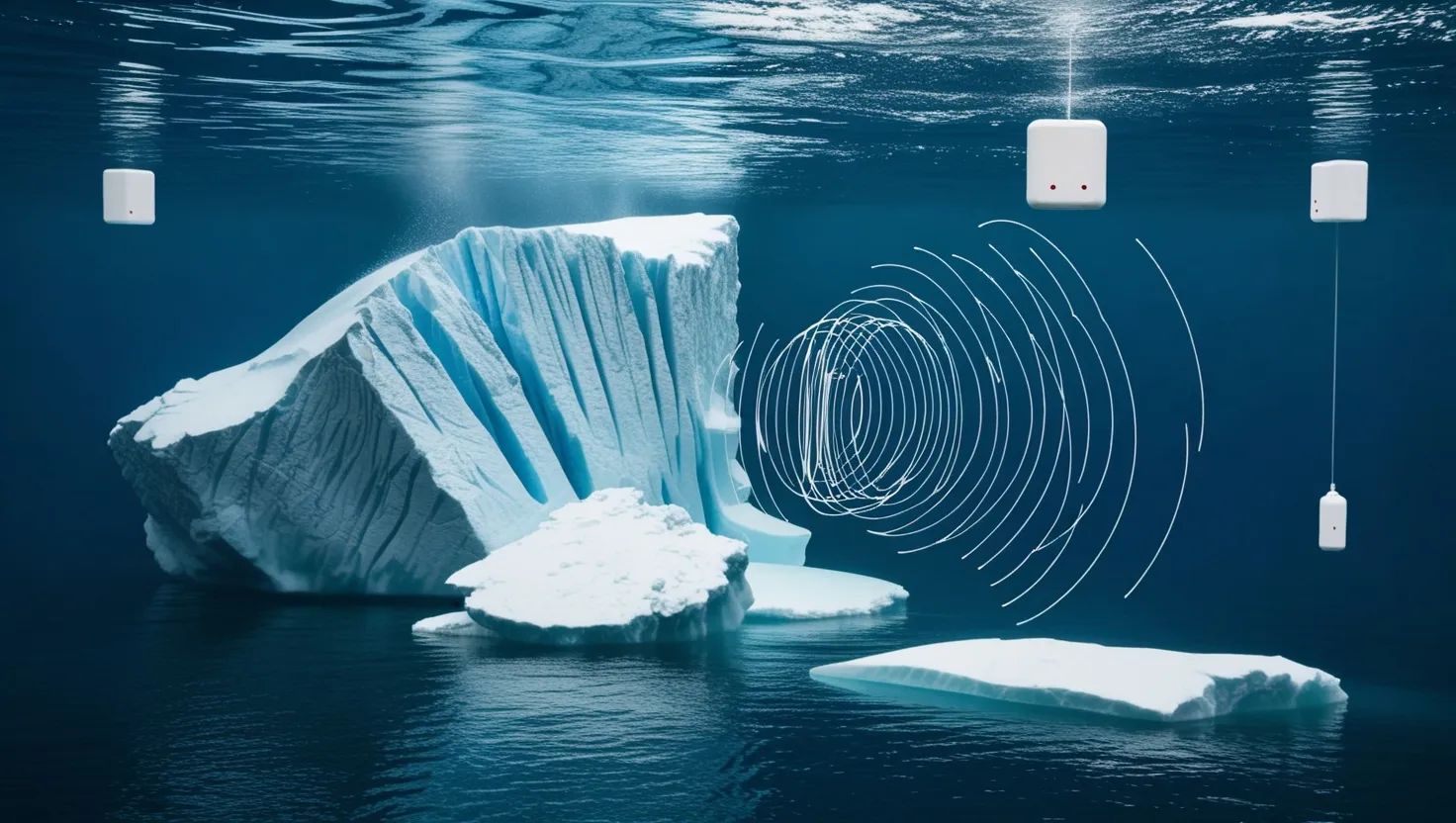
What exactly is an ice quake? Think of it this way. Imagine a massive glacier, miles and miles of solid ice, sitting at the edge of the ocean. Gravity pulls it downward. Water underneath it shifts. The pressure builds up. Eventually, enormous chunks of ice break off and crash into the water. When they do, they crack, splinter, and fracture. These fractures release energy. They generate sound. The sound travels through seawater, which is actually an excellent medium for acoustic transmission, allowing these sounds to travel extraordinary distances.[2] By 2012, NOAA had concluded that this explanation—ice calving and related cryoseismic activity—best fit the available evidence.[2]
But did this completely solve the mystery? Not entirely. Some researchers, including oceanographer Christopher Fox, noted something interesting. The Bloop’s acoustic signature showed rapid variations in frequency that were genuinely similar to sounds made by marine animals, more so than typical ice quake patterns.[2] This didn’t mean it was definitely an animal, but it was enough to keep some scientists thinking. A few marine biologists suggested that the biological origin theory shouldn’t be completely dismissed.[2]
Here’s what fascinates me about this situation: we had a real mystery, and we arrived at a reasonable explanation, but the explanation doesn’t completely erase all the unusual aspects. The Bloop had characteristics that didn’t perfectly match the ice quake model. It had characteristics that resembled biological sounds. Neither explanation is perfect. Neither fully accounts for all the features we observed.
Have you ever noticed how mysteries sometimes don’t get resolved the way we expect them to? We want a definitive answer, a moment where everything becomes clear. The Bloop teaches us that sometimes we get “probably this” rather than “definitely that.”
The sound also traveled through something called the SOFAR channel—the Sound Fixing and Ranging channel.[3] This is a horizontal layer in the ocean where sound waves get trapped and can travel enormous distances with minimal degradation. It’s like an underwater highway for sound. The specific frequencies of the Bloop were perfectly suited to travel through this channel, which explains how such a sound could be detected across thousands of kilometers. This technical detail is important because it shows how the environment itself shapes what we can hear and how far sounds travel.
One thing that made the Bloop particularly intriguing was its rarity. It was detected in the summer of 1997 and then essentially disappeared. We never heard anything like it again.[1] In the same year, other mysterious sounds were recorded, including one called “the Slowdown,” which lasted seven minutes and gradually decreased in frequency.[1] These weren’t isolated incidents, but they also weren’t common occurrences. What does it mean when something happens once, dramatically, and then never happens again? It suggests something singular—either a one-time event or a phenomenon we don’t fully understand yet.
Consider what this tells us about the ocean. We deploy sophisticated monitoring equipment. We listen carefully. We analyze what we hear. And sometimes, the ocean produces something that still doesn’t fit our categories perfectly. This is humbling. We live on a water planet. The ocean covers seventy percent of Earth’s surface. We’ve explored less of it than we’ve explored the surface of the moon. In that vastness, in that darkness and pressure, what else might be producing sounds we haven’t heard?
The Bloop represents something valuable in science: a problem that doesn’t have a clean solution. The most likely explanation—ice quakes—is supported by reasonable evidence. But the event’s unusual characteristics keep the door slightly open for other possibilities. This is how science actually progresses. We don’t always get absolute certainties. We gather evidence, we form the best explanations we can, and we remain open to new information.
Think about the implications for a moment. If ice quakes of this magnitude can be produced in Antarctic waters, what does that tell us about global climate change? As polar ice continues to melt due to warming temperatures, more glaciers are fracturing and falling into the ocean. More ice quakes may occur. More sounds like the Bloop might be generated. The ocean’s acoustic environment is changing, and we’re just beginning to understand the consequences.[1]
The Bloop also transformed how we think about ocean monitoring. Before this event, hydrophone networks were primarily designed to detect military submarines or nuclear tests. The Bloop showed us that these same instruments could reveal natural phenomena on a grand scale. It opened new possibilities for oceanographic research and environmental monitoring. Scientists realized that by listening to the ocean, we could learn things about glaciers, climate, and marine life that traditional observation methods might miss.
What strikes me most about the Bloop is how it represents a moment of genuine wonder in modern science. We had technology, data, and expertise. We were still puzzled. We still didn’t have all the answers. In our age of information, where we can access almost anything instantly, the Bloop reminds us that mysteries remain. The ocean still has things to teach us. Nature still has ways of surprising those who pay attention.
The story of the Bloop is really a story about human curiosity, scientific investigation, and the limits of our knowledge. It shows us that even with sophisticated equipment and brilliant minds, the natural world can produce phenomena that resist easy categorization. It demonstrates that good science isn’t about having immediate answers—it’s about asking good questions and following the evidence, even when that evidence leads to conclusions that are “probably this” rather than “definitely that.”
So the next time you think about the deep ocean, remember the Bloop. Remember that in 1997, something down there made a sound so powerful that it traveled thousands of kilometers. We think we know what made it. We have a reasonable explanation. But we also know that the ocean is vast, deep, and full of secrets. Perhaps the Bloop was an ice quake. Perhaps it was something else. Perhaps it was a singular event that will never repeat. Or perhaps, somewhere in those deep waters, other sounds are being made right now, traveling through the SOFAR channel, reaching hydrophones we’ve placed to listen. And we’re hearing them, analyzing them, trying to make sense of them. That’s the real message of the Bloop: the process of discovery never really ends. The ocean is always speaking. We just have to listen carefully enough to hear what it’s trying to tell us.