Back in 1945, after six grueling years of conflict, the Allies finally defeated Germany. By July, the top leaders—Roosevelt, Churchill, and Stalin—met at the Potsdam Conference to decide Germany’s fate and divide the spoils of war. While they seemed friendly in public, behind closed doors was a different story, filled with distrust and arguing. Stalin thought Churchill was weak, and Roosevelt was upset by Stalin’s demands for war reparations. Despite being allies, the U.S. and the Soviet Union weren’t friends. Potsdam was the end of one war and the start of another.
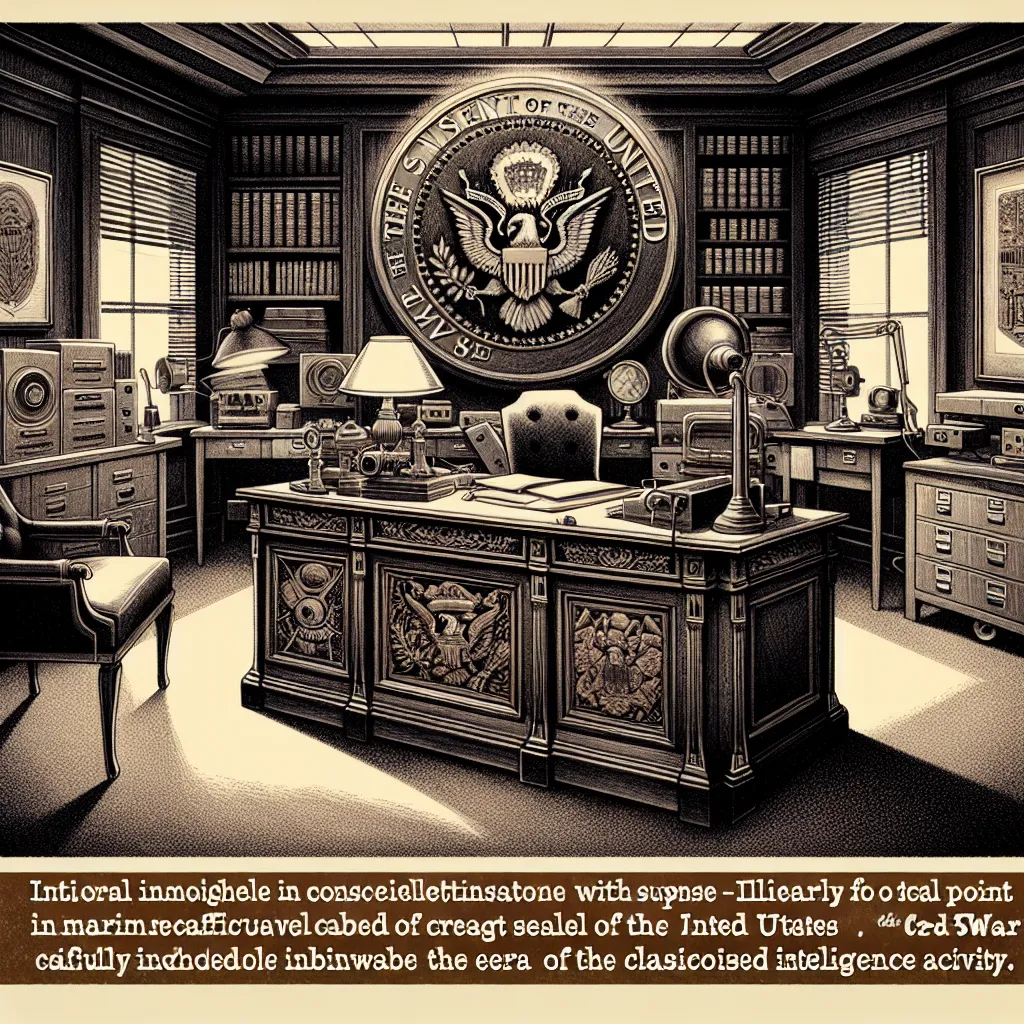
On August 4, 1945, not long after Potsdam, U.S. Ambassador William Averell Harriman received a striking gift from Soviet children: a wooden replica of the Great Seal of the United States. These kids were part of the Vladimir Lenin All-Union Pioneer Organization, akin to extremely patriotic Russian Scouts. Harriman was so pleased with the gift that he hung it in his Moscow office, unaware it was more than just a decoration.
This wooden seal was actually a high-tech bug, placed right behind the ambassador’s desk, capable of eavesdropping on private meetings for years. The Soviets could hear everything said in that room, despite the extensive security measures the Americans had in place. They called the device “The Thing,” and it stayed undetected for seven years, overhearing conversations involving top officials like generals, the Secretary of State, and even the President.
The Thing, invented by Russian scientist Leon Theremin, was groundbreaking. Theremin was known for creating one of the first electronic musical instruments, the theremin. After being forced back to the Soviet Union and put in a Siberian gulag, Theremin chose to work in a secret lab over breaking rocks. There, he developed advanced surveillance tech, including The Thing.
The Thing didn’t need its own power source. It activated by a strong external radio beam, making it effectively inert when not in use. This ingenious design kept it hidden until 1951 when a British radio operator accidentally intercepted the frequency during a routine scan. Not long after, further sweeps revealed The Thing’s location, hanging on the wall.
For seven years, The Thing captured sensitive info, which the Soviets used to their advantage. It even intercepted conversations involving General Eisenhower and other high-profile guests. When finally discovered, The Thing was immediately sent to Washington for analysis.
The U.S. didn’t disclose the discovery until 1960, using it to counter Soviet accusations of American spying after a U-2 spy plane incident. Presented at a United Nations meeting, The Thing underscored that spying went both ways. It swayed the UN vote against the Soviet resolution, affirming the complexity of Cold War espionage.
The Cold War was an era of intense paranoia and high stakes, where even children’s gifts could be tools of international espionage. The discovery of The Thing highlighted the lengths to which both sides went to gain an edge, deepening the conflict and bringing the world closer to the brink of nuclear war.