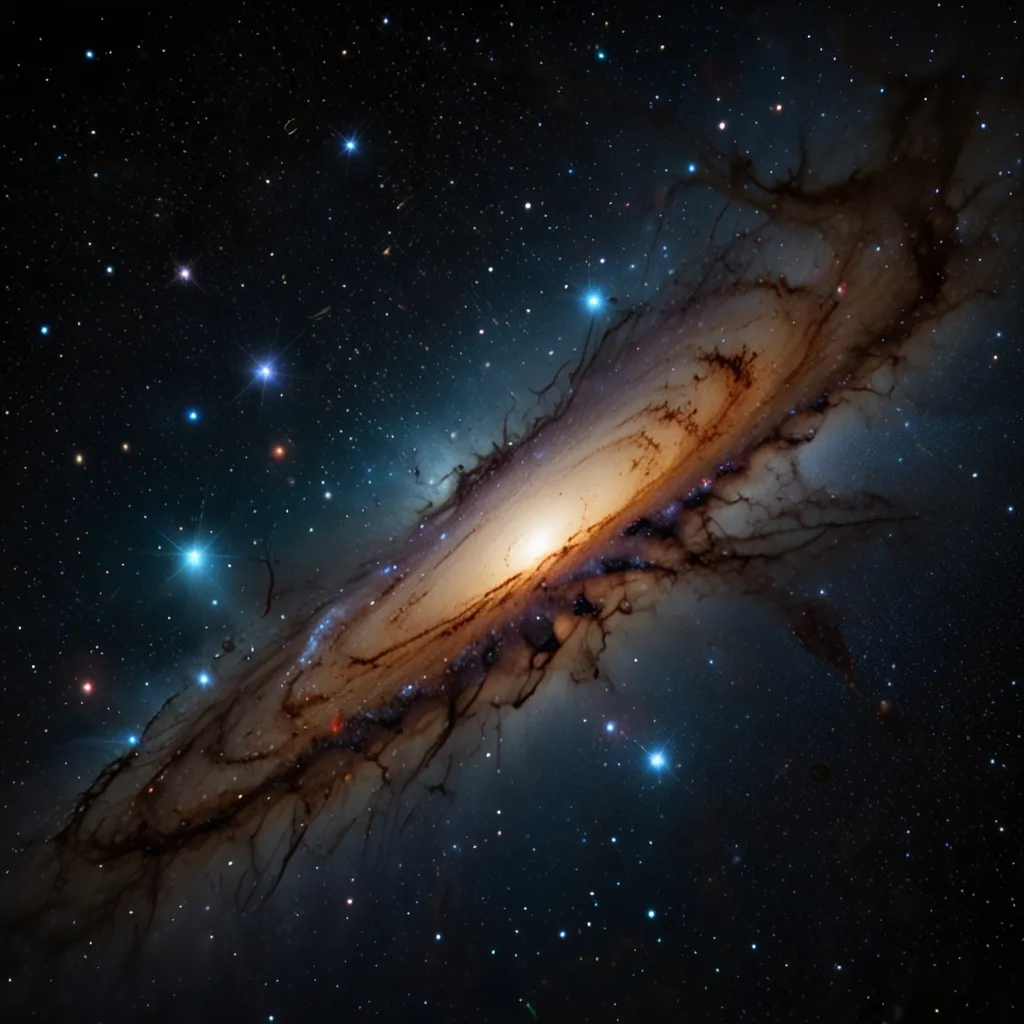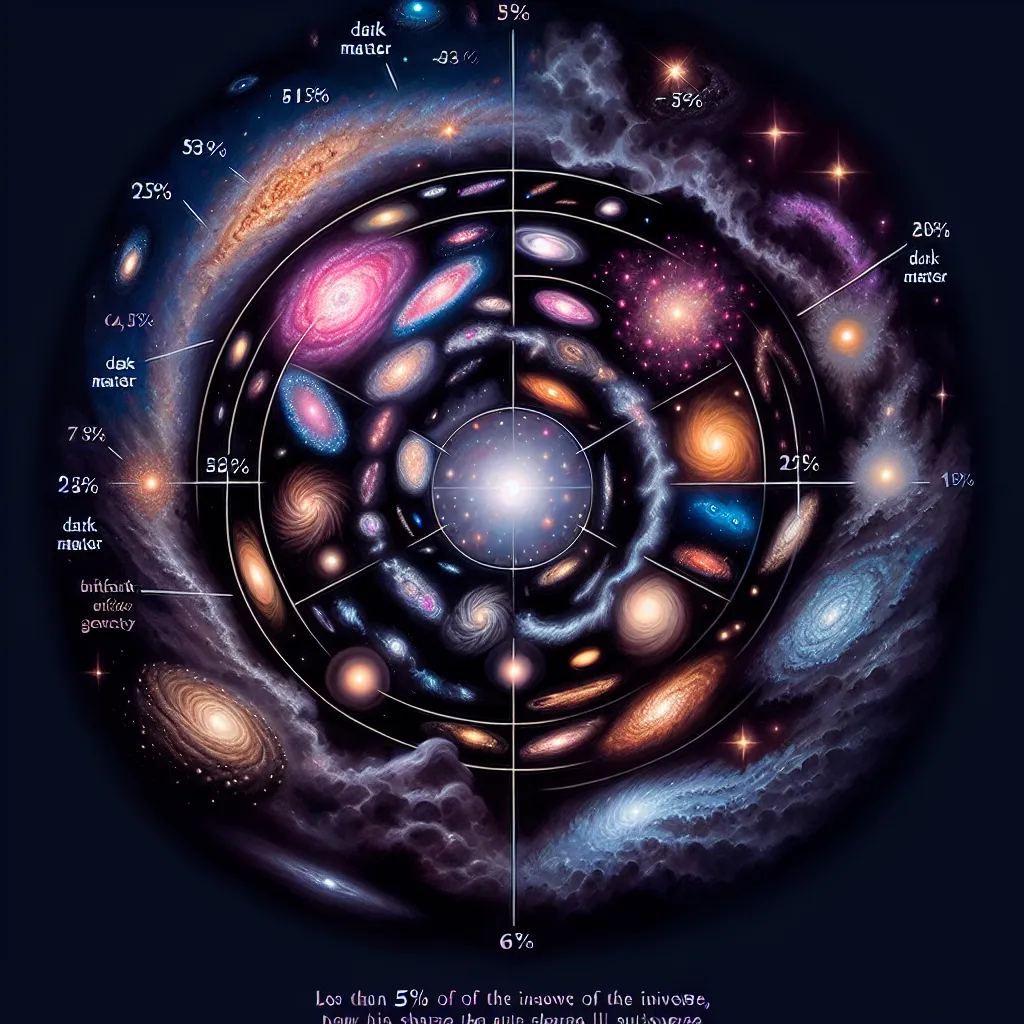
Matter, as we know it—atoms, stars, galaxies, planets, trees, rocks, and us—makes up less than 5% of the known universe. About 25% is dark matter, and a whopping 70% is dark energy, both invisible. This is mind-blowing because it means we only experience a tiny sliver of reality.
Dark matter is crucial as it allows galaxies to exist. When we try to understand the universe’s structure, it becomes clear that normal matter isn’t enough. The gravity from visible matter alone can’t hold galaxies together. Stars would scatter without the gravitational pull of something else—this something doesn’t emit or reflect light—it’s dark matter.
We can infer the presence of dark matter because regions with high concentrations of it bend light passing nearby. This shows it interacts with gravity. However, we have many ideas about what dark matter isn’t rather than what it is. It’s not clouds of normal matter or anti-matter, nor is it made up of black holes. What we do know for sure is: something is out there, it interacts with gravity, and there’s a lot of it.
Dark energy is even more mysterious. We can’t directly detect or measure it, but we can see its effects. In 1929, Edward Hubble discovered that the universe is expanding by observing the redshift in light from distant galaxies. Recent findings reveal this expansion is accelerating, contrary to the older belief that gravity would eventually slow or reverse it.
Dark energy might be intrinsic to empty space itself. As the universe expands, more space appears, and this might lead to an accelerating expansion. Einstein’s idea of a cosmological constant fits here, although calculations related to it remain baffling. Another hypothesis is that empty space is full of temporary particles which could be causing this phenomenon. Or, it could be a new form of dynamic energy fluid.
Our ideas about dark matter and dark energy are still theoretical. On the one hand, this is frustrating, but it also makes the field exciting as we sit on the frontier of discovery. It’s a humbling reminder that we, humans with all our technology, still have so much to learn about our universe. And that, in itself, is awesome.