Will the Universe Hit the Self-Destruct Button?
Unmasking the Universe's Hypothetical Self-Destruct Button: A Tale of Quantum Fields and False Vacuums
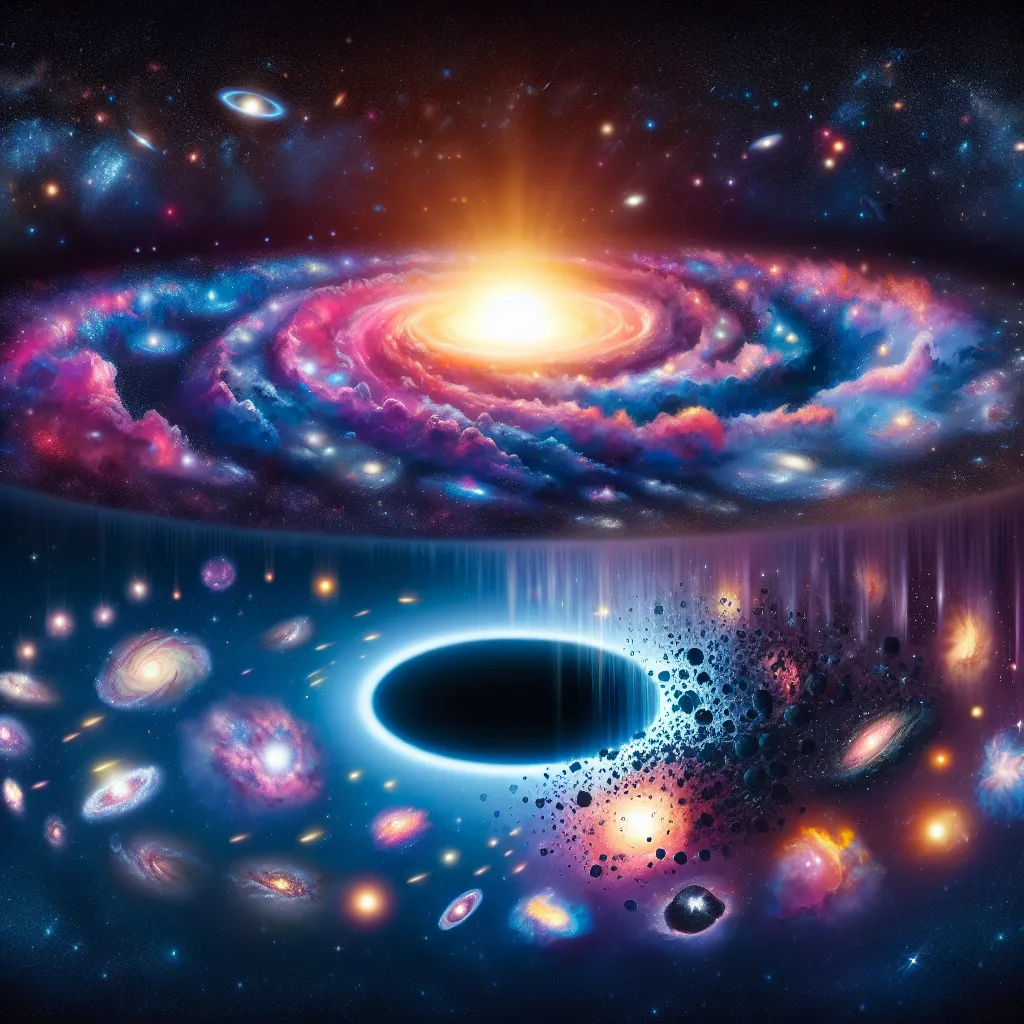
Imagine if the universe had a self-destruct button, capable of eradicating every physical thing in existence instantly, making life impossible forever. This nightmare scenario is called vacuum decay.
To understand how our universe could potentially annihilate itself, we need to break down two key concepts. First, energy levels. In physics, everything has an energy level. The higher the energy, the more active it is. For example, wood has a high energy level because it can be burned to release stored chemical energy, leaving behind lower-energy ash.
Second, stability. Everything in the universe strives to reach a ground state, the point of lowest energy and maximum stability. Think of a ball on a hill—unstable and full of potential energy. Disturb it, and it will roll down to the valley, losing energy, and eventually become stable in its ground state. Everything, even in the quantum realm, follows these rules.
Now, our universe operates based on quantum fields, which dictate how particles behave and interact. All these fields aim to reach their vacuum state, or lowest energy level. The Higgs Field, crucial in giving particles their mass, might not be in its true ground state but in a false vacuum. This means it appears stable but isn’t, much like our ball on a shallow hill with a deeper valley lurking nearby.
If the Higgs Field is truly in a false vacuum, it holds massive potential energy, acting like wood soaked in gasoline. A random quantum event could trigger this energy release. If this vacuum decay starts anywhere in the universe, it will initiate a chain reaction. The Higgs Field would drop to a lower energy state, releasing an immense amount of energy and creating a growing sphere of true vacuum at the speed of light, erasing everything it touches from existence.
This sphere would not only destroy life but also disrupt the fundamental laws of physics. The very fabric of reality would change, making life as we know it impossible. Inside this true vacuum, the standard model of physics would no longer apply, and we have no idea what that would mean.
But don’t worry too much. The concept of a false vacuum is still speculative, based on our current yet incomplete understanding of particle physics. It’s like measuring a continent with a flimsy ruler—possible but not very accurate. Plus, even if a vacuum decay has started far away, the vastness of the universe means it might never reach us.
While the idea of vacuum decay is chilling, there are more immediate and manageable threats we should focus on. So, keep calm and remember that some scary ideas might just stay in the realm of theory forever.