5 Physics Mysteries That Challenge Everything We Know About Reality and Time
Explore 5 mind-bending physics mysteries that challenge everything you think you know about reality. From time's arrow to glass paradoxes - discover why science's biggest questions remain unsolved.
Let’s start with a question that seems simple but keeps physicists awake: why is the universe the way it is, instead of some other way? You’d think, as decades and centuries pass, science would smooth the edges off the unknown. Yet, some cracks in the foundation get deeper the more closely you look. I want to invite you into five puzzles that aren’t just unanswered—they’re weird in a way that messes with your sense of what’s supposed to make sense.
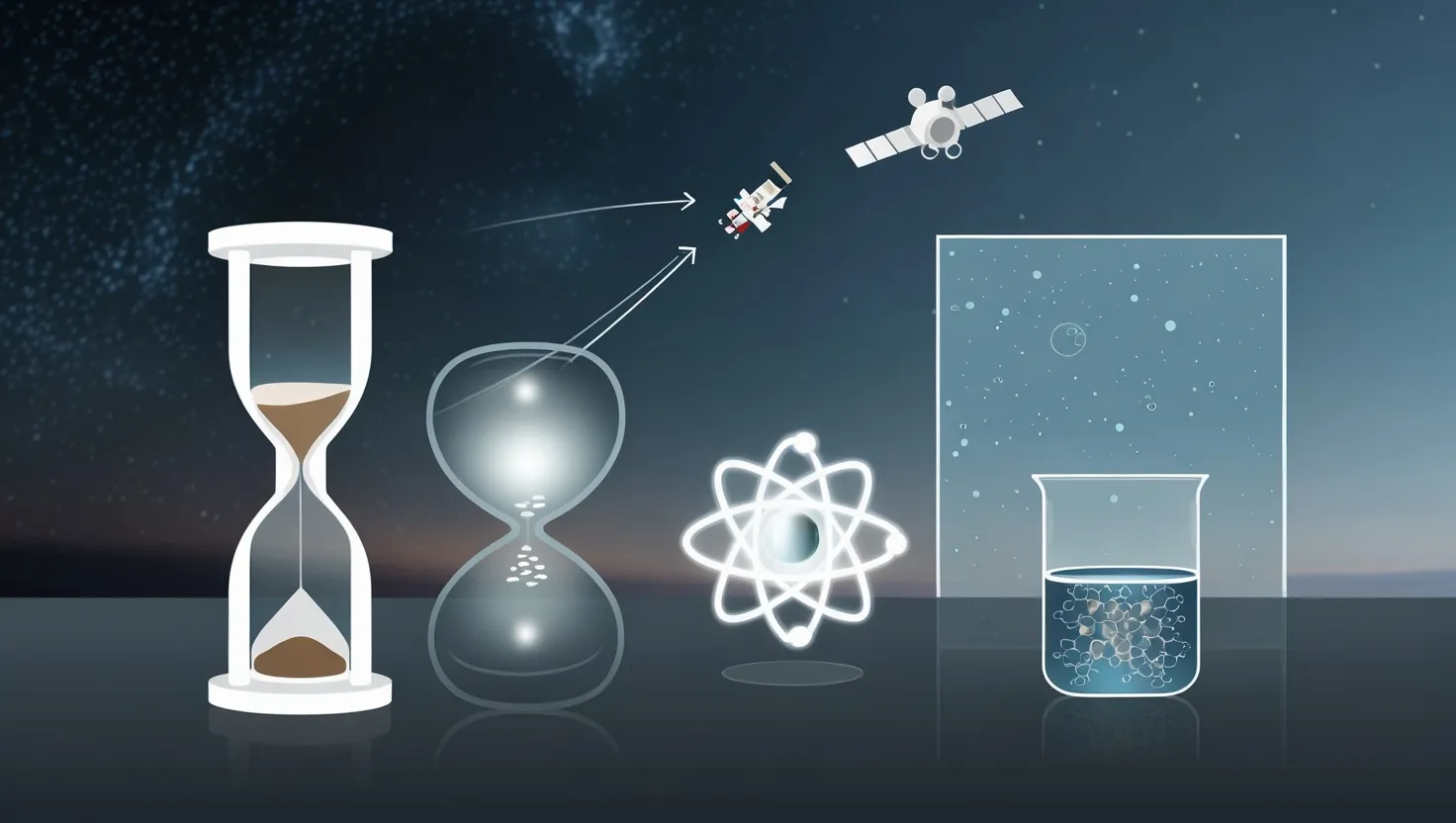
If you watch a movie of an egg falling and splattering on the kitchen floor, you know instantly if it’s being played backward. The broken egg never leaps up and reassembles. Yet at the tiniest scales—the realm of atoms and quarks—the laws describing their behavior don’t prefer forward or backward. Why does time so stubbornly push in just one direction for us? It’s not only a question about clocks ticking or calendars turning. It’s about the difference between possibility and impossibility: you can scramble eggs but you can’t unscramble them. Some say the answer lies in entropy, that it always increases. “Time is what keeps everything from happening at once,” wrote Ray Cummings. And yet, the laws guiding particles seem indifferent. Could it be that our entire sense of cause and effect, of memory and expectation, rides on some fundamental cosmic asymmetry that’s waiting for a better explanation?
If you’d sit under a starry sky and think about what’s holding all those atoms together—why buildings, mountains, and your own body don’t just dissolve into a puff of particles—you’d encounter the mystery of the proton. The workhorse of the atomic nucleus, the proton is supposedly able to hold itself together for longer than the universe has existed. Yet, if some grand theories are right, every once in a long while a proton should simply fall apart. Large underground detectors, built with almost religious patience, watch for this single event: the shudder and flicker of a proton collapsing. Nothing. Not a peep. Is the proton more stable than theory allows, or have we simply missed its most secretive act? What vision of the subatomic universe would explain why all the matter around us persists?
Speaking of things not adding up, consider the Pioneer probes—metallic messengers that zipped away from the sun in the last century. Launched to skim the edges of our solar system, they kept drifting a little slower than calculations predicted. The deceleration was tiny, but unmistakable. Many proposed that heat radiating from their electronics nudged them; the physics was messy, but explained most of the oddity. Yet some uncertainty lingers, making the episode a reminder: when something seems off, the explanation isn’t always tidy. What else might we miss in the chaos and clutter of real-world measurements? Is this just engineering noise, or does it hint at subtle tweaks lurking in our models, waiting to be noticed?
Now, let’s talk about mistakes—brilliant, ambitious ones that teach as much as correct answers. In the 1960s, a group believed they’d discovered a new form of water: polywater. Thicker, behaving strangely, it looked like a new chemical reality. Some speculated wildly—could this stuff transform everyday matter? Could it threaten the world’s water supply? Eventually, polywater was debunked as an artifact of impure samples, contaminated by sweat, glass, or dust. The idea was dazzling—and false. But it wasn’t wasted effort. Episodes like this force us to question how we know what we know. How easily can our senses and machines be fooled? If even the rigor of chemistry can stumble, what more humble fields go wrong quietly, never corrected or even discovered? “Science is a way of thinking much more than it is a body of knowledge,” Carl Sagan reminded us. The lesson: doubt is not a flaw. It’s the lifeblood of progress.
Here’s a challenge for your intuition. Take a windowpane. Is glass a solid or a liquid? For centuries, people claimed that old stained glass in churches had “flowed” downward, making the bottom thicker. In truth, this is an exaggeration, but it hints at something real: glass is not a typical solid. At a molecular level, its atoms are without the tidy symmetry of a crystal. When cooled from a melt, its structure “freezes” into a disordered state, hard but subtly out of equilibrium. This “glass transition” baffles chemists and physicists alike. The more you try to draw a sharp line between liquid and solid, the blurrier it becomes. Is glass still ever-so-slowly flowing, or is it truly fixed and rigid? The answer depends on where you look, and how closely. Is it possible our ordinary categories—liquid, solid, gas—hide more complexity than they reveal?
These puzzles share something deeper: they trap us at the edge of understanding, often balancing between blindingly simple questions and answers that slip through our fingers. For the arrow of time, maybe the clue sits not just in math, but in the way living things remember the past but not the future. When I scramble eggs or watch a movie reverse, I’m not just seeing physics—I’m experiencing a fundamental constraint, the cost of living in a universe that values entropy.
The proton stability dilemma isn’t just about elementary particles, either. It’s a matter of existential importance. If protons decayed rapidly, matter would never stick around long enough for stars or people. The universe would be stripped of complexity. So, every “failure” to detect proton decay is a vote for the persistence of the ordinary world. Yet, it’s not proof that it will last forever.
Whenever we talk about spacecraft deviating from planned paths, or failed claims like polywater, we’re really talking about the blurry boundaries between certainty and error. Science, for all its rigor, thrives on exceptions, on those moments where data doesn’t fit and someone dares to question.
And glass—think about it the next time you look out a window. It’s not just a barrier to the wind. It’s a reminder that nature makes room for paradox, that categories can refuse to cooperate, that “solid” and “liquid” are labels we slap on a far messier reality. If the world preferred to be simple, it’s had ample opportunity to do so.
There’s another layer to all these stories. Often, the more collective work scientists pour into a problem, the more they appreciate just how much remains mysterious. Sometimes the absence of evidence—whether a proton refusing to decay or a spacecraft’s slight lag—says as much as any discovery.
So what if some of these stories divide experts, or seem unsatisfyingly incomplete? Maybe the lesson is to stay curious, to allow for uncertainty. The universe isn’t interested in conforming to our intuitions. The best questions are those that withstand centuries of answers and continue to mutate, multiply, and provoke.
Let me leave you with a thought from Richard Feynman: “I would rather have questions that can’t be answered than answers that can’t be questioned.” Isn’t that what makes these mysteries so powerful? Their resistance to tidy solutions keeps us looking, tinkering, asking. Maybe the greatest puzzle is not a specific phenomenon at all—but the endless human urge to wonder at what remains just beyond reach.