5 Solar System Mysteries That Still Baffle Scientists and Challenge Everything We Know
Discover 5 unsolved solar system mysteries that challenge our understanding of planetary science. From Jupiter's eternal storm to Saturn's hexagonal pole. Learn more.
Let’s admit it: the solar system is hardly the tidy, well-understood family of planets and moons we memorized in school. With every probe, new telescope, or handful of cosmic rocks we analyze, the whole arrangement grows stranger. Some puzzles are so persistent, so immune to easy logic, that they reshape how I think about the planets floating alongside Earth. Consider these five lingering riddles—each a sharp reminder that for all our knowledge, the universe takes most of its secrets to heart.
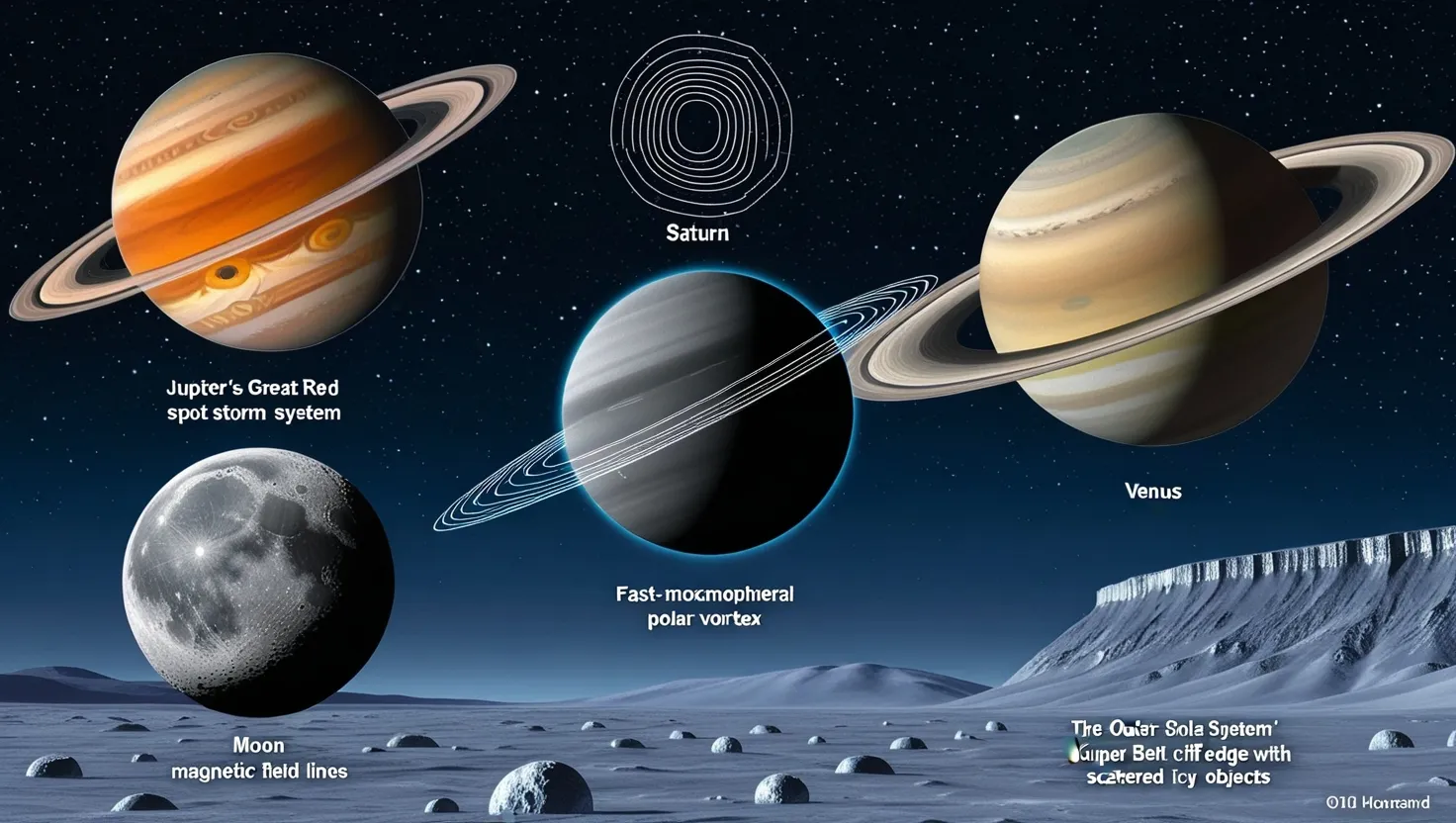
Let’s start with a scene you’ve pictured a hundred times: Jupiter, streaked with tan and orange, sporting that infamous marbled wound—the Great Red Spot. This storm is well over a century old, maybe even much older, pinwheeling with winds that would rip the hardiest hurricane to shreds. Yet here’s the odd part: storms on Earth burn out when their ingredients—heat, moisture, differences in pressure—run out. But Jupiter’s monster storm seems to run on, defying the same laws we trust at home. Scientists have suggested that perhaps energy from the planet’s deeper layers or turbulence from surrounding jet streams sustain it, but no sweep of models or equations has nailed the cause. Even the source of its red color is ambiguous—a chemical byproduct, perhaps, but from what process? Some believe similar storms might have appeared and faded before this Spot, meaning the version we see now isn’t as ancient as we think. Still, no one can say for sure. Why hasn’t this storm lost strength or simply spun itself apart after so long without a “surface” for weather systems to crash against? “Somewhere, something incredible is waiting to be known,” as Carl Sagan wisely put it.
Shifting attention outward, Saturn’s polar hexagon may be even stranger. Here, instead of an ellipse or circle around the north pole, we encounter a flawless six-sided jet stream, thousands of kilometers across. You can trace each edge with your finger. This hexagon doesn’t drift, doesn’t morph into something else. In the world of physics, especially fluid dynamics, such spontaneous geometric order is a shock. Why a hexagon, and not a square, a pentagon, or a wobbly ring of clouds? Experiments with rotating tanks have mimicked this pattern on small scales. Yet, Saturn’s size, fluctuating wind speeds, pressures, and deep gas layers should create far less predictability. That the hexagon persists—when most atmospheric features dissolve or shift within weeks—poses not just a curiosity but a challenge: Are we missing a basic rule about how gases move under high pressure and rapid rotation? Or is this a one-in-a-million coin toss drawn out across cosmic time? “Men love to wonder, and that is the seed of our science,” said Ralph Waldo Emerson, and Saturn’s hexagon remains a curiosity that keeps scientists wondering.
Now let’s take a detour to Venus. Imagine its surface: hidden under thick yellow clouds, scorched and pressurized beyond comprehension. Yet, the true oddity isn’t the planet’s heat, but how its winds behave. Overhead, Venus’s clouds zip completely around the globe every four days, moving more than 60 times faster than the planet spins itself. Earth’s jet stream is a breeze by comparison. This “super-rotation” isn’t just fast; it’s inexplicable. Friction inside the atmosphere, combined with heat distribution, should slow things down. Instead, something accelerates the winds and keeps them moving at breakneck speeds. Is it massive, unseen tidal forces? Electric fields? A delicate feedback loop set in place long ago? Theories run rampant, but none convince everyone. Here, the question arises: Is Venus’s climate the exception that proves the rule, or are we missing fundamental laws of planetary weather? Sometimes I wonder: If we really understood Venus’s upper winds, would we think differently about Earth’s own fragile atmosphere?
Glancing up at our Moon, you may think you know its story: dry, dead, and largely unchanged for eons. Yet, samples brought back from the Apollo missions tell a more tangled tale. Some ancient lunar rocks show they were magnetized—evidence that a strong, global magnetic field once swept across the Moon, as powerful in its youth as Earth’s is today. But the Moon is small, its core tiny, and, as far as we know, ill-suited for generating a lasting “dynamo”—that engine of spinning molten metal which gifts our home planet its magnetic shield. How could such a delicate body light up a mighty, planet-scale field? Alternative ideas have emerged: perhaps giant impacts jostled the core into action, or maybe an early, once-molten mantle churned for centuries. Or was the Moon’s field somehow external, perhaps induced by a more active Earth billions of years ago? The only constant is doubt—the same doubt that inspires me to keep searching for unlikely explanations.
Finally, let’s sail to the system’s edge—to the Kuiper Belt. Here, past Neptune, chunks of rock and ice orbit the Sun—remnants from planet-building days. But as astronomers mapped these objects, they found a startling cliff. Around 50 astronomical units from the Sun, the swarm thins abruptly—as if an invisible blade sweeps clean the leftovers. Was a past giant planet ejected, abandoning chaos at the threshold? Could there be a dark, heavy world we’ve never spotted, its gravity tossing smaller bodies outward? Or is this simply the place where the solar disk ran out of raw material, starved as the newborn Sun blasted away the last gas and dust? Each possibility points to dramatic events that shaped our cosmic address, yet the precise cause remains hidden, as if challenging us to redraw the boundary between planet and empty space.
Throughout this list, a theme emerges: for every answer in planetary science, there are a dozen better questions. Our models predict, but nature improvises. These mysteries aren’t just curios—they echo in the methods and instruments we design, in how we imagine other worlds, and in what we expect to find when we finally look. “Science is not only a disciple of reason, but, also, one of romance and passion,” wrote Stephen Hawking. I can’t help but agree. If the solar system taught me everything I needed to know, I’d have stopped looking up long ago. Instead, each unresolved puzzle nudges me to think, to question, and, most importantly, to wonder: What will we learn next, and how will it rewrite the story we thought we knew? Have you ever considered that the next substantial breakthrough in understanding our planetary neighborhood might come not from a billion-dollar spacecraft, but from someone simply asking the right question?
So, the next time you look at Jupiter’s swirling spot, or Saturn’s impossible hexagon, remember—these are not just weird observations in astronomy textbooks. They are living mysteries. Each keeps experts up at night, and each, regardless of when or how it’s solved, pushes the entire planet forward a little more in its quest to grasp what lies overhead. If you could solve one, which would you choose—and what new questions might it reveal?