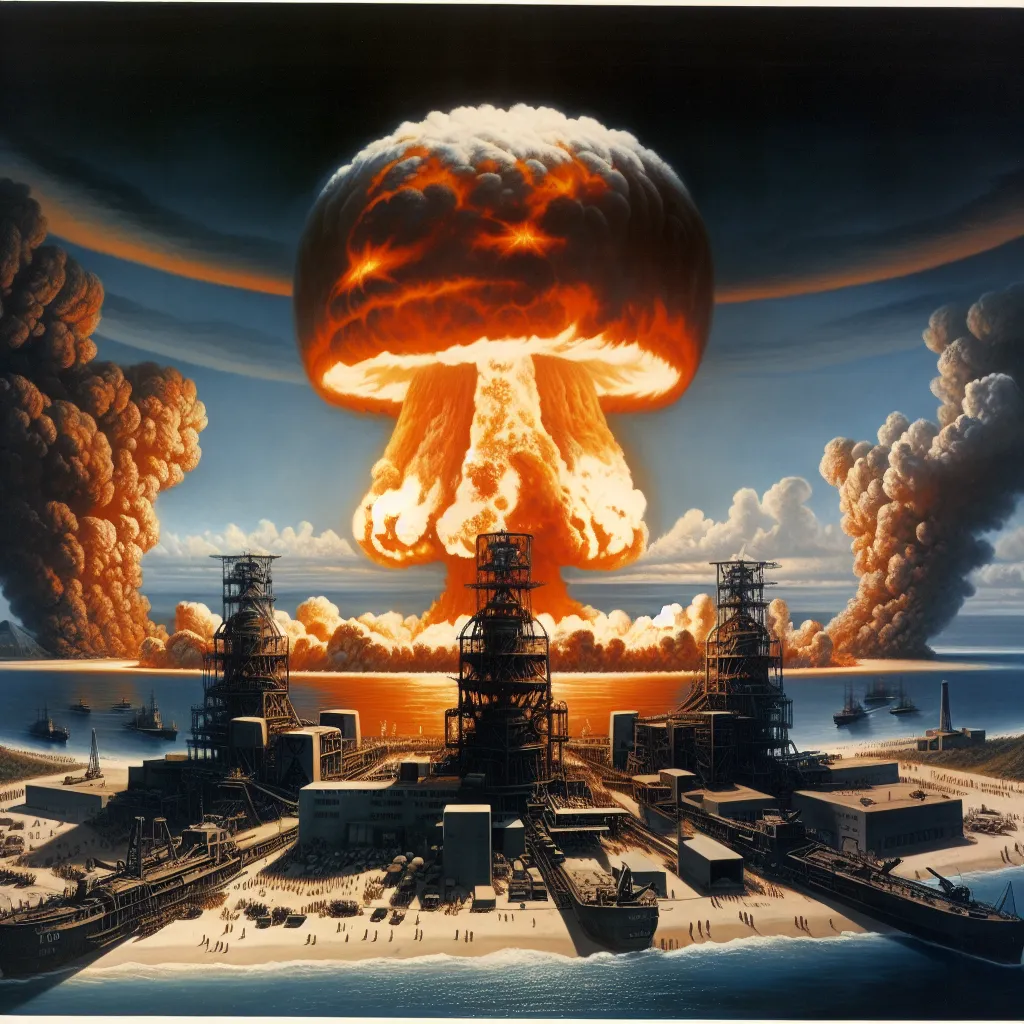
November 1, 1952, was a day that changed the world forever. In the remote Marshall Islands, U.S. scientists pressed the button that ushered in the era of the hydrogen bomb. This weapon was a colossal leap from the atomic bombs dropped on Hiroshima and Nagasaki. Unlike those bombs, which used a process called fission to split atomic nuclei, the hydrogen bomb used fusion. In fusion, hydrogen nuclei are forced together to form helium, releasing an unimaginable amount of energy.
The process starts with a high explosive that triggers a fission reaction, creating extremely high temperatures. In this intense heat, hydrogen nuclei fuse, forming helium and releasing a colossal explosion. The hydrogen bomb opened the floodgates to a new level of destructive power, with almost no upper limits.
With the hydrogen bomb, the U.S. held the lead in the arms race—at least for a while. But on October 30, 1961, the Soviet Union dropped the most powerful bomb ever detonated, known as the Tsar Bomba. Weighing 27 tons, this hydrogen bomb set off an explosion 3,800 times more powerful than the bomb dropped on Hiroshima. Its fireball was visible from over 600 miles away, and the shockwaves circled the Earth three times. This massive explosion highlighted an age of mutually assured destruction, where enough nuclear weapons existed to annihilate humanity several times over—a reality that looms over us even today despite numerous treaties.
In just a thousand years, explosive power has escalated by hundreds of millions of times. Yet nuclear bombs carry a heavy burden. They leave the land they touch barren and pose a deadly threat for thousands of years. The quest for an ultimate, cleaner, and more precise explosion continues. In the aftermath of the Atomic Age, scientists hope they might be on the brink of discovering a key to harnessing the immense power in a more controlled manner.