During World War I, the use of massive guns took a dramatic leap with the introduction of Bertha, the German siege gun. Bertha was a formidable piece of artillery capable of launching an 800-kilogram shell over 13 kilometers, causing significant devastation. World War II saw the emergence of even larger super cannons, each with names to instill fear in their enemies. Among these giants was Annie.
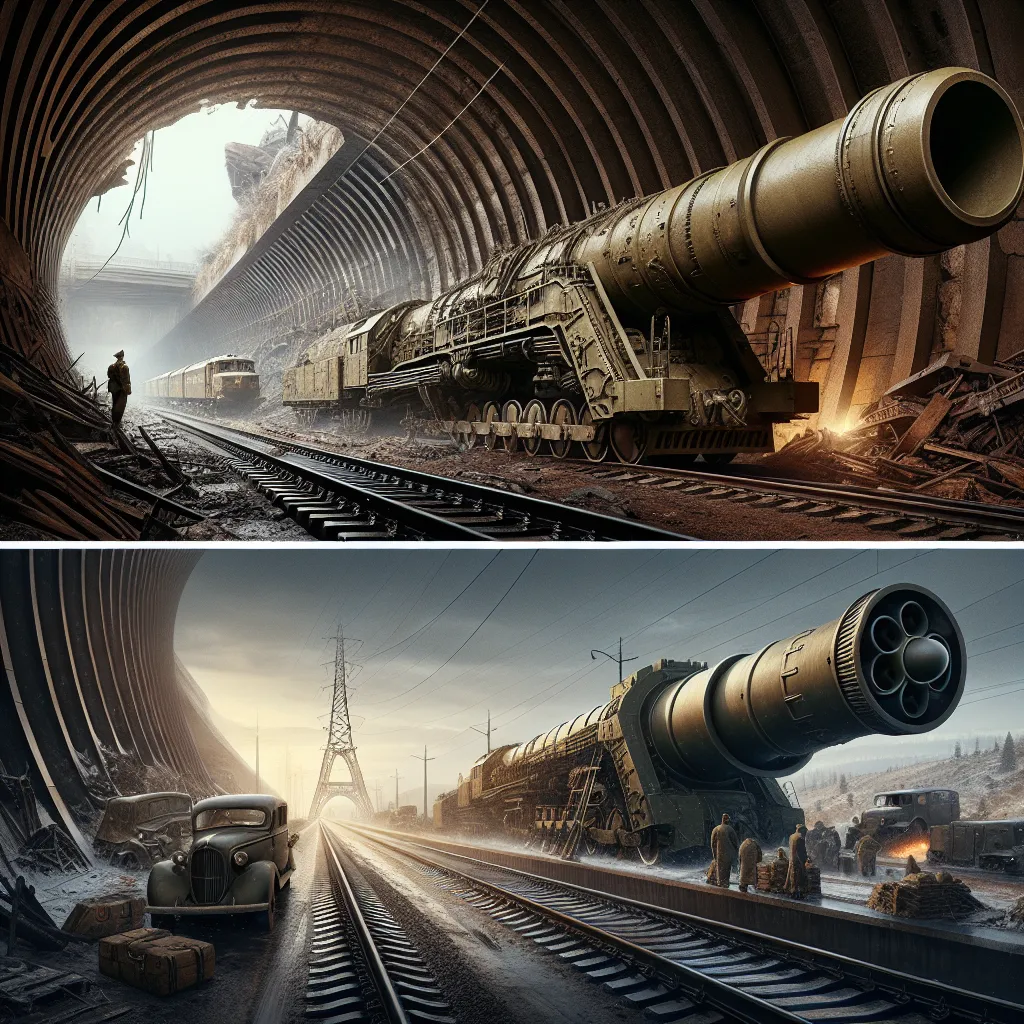
Annie, one of 25 enormous railway guns developed by the Krupp steelworks, was part of the K-5 series. These guns were initially designed to penetrate the French Maginot Line, capable of launching quarter-ton projectiles up to 50 kilometers. Although they never saw action against the Maginot Line, Annie and her counterparts were deployed in various sieges.
Most famously, Annie made her mark during the American invasion of Anzio, Italy, in early 1944. Hidden in rail tunnels overlooking the coastline, Annie rained heavy explosive shells down on the 70,000 Allied troops for over two months. This relentless barrage earned her the nicknames “Anzio Annie” and “The Anzio Express.” The K-5’s 288-millimeter caliber barrel, featuring 12.7-millimeter rifling grooves, made it not only massive but also remarkably precise.
However, Annie’s size eventually became her greatest weakness. The need for railway tracks to move the gun made it vulnerable, as these tracks provided clear paths for Allied bombers to follow and locate the artillery. The very infrastructure that made the K-5 efficient also paradoxically led to its downfall.
Fast forward to January 20th, 1953, amid the Cold War era, former World War II General Dwight D. Eisenhower was inaugurated as President of the United States. The inauguration parade showcased modern military might, including a brand-new 280-millimeter cannon. During the early ’50s, the U.S. was fervently exploring ways to deliver nuclear payloads, including through artillery.
The result was the M65 howitzer, which could launch nuclear warheads. Dubbed “Atomic Annie,” this massive self-propelled gun weighed 78 tons and measured 26 meters in length. Advances in mechanics allowed Atomic Annie to be set up in just 15 minutes. In May 1953, it successfully fired an 800-pound nuclear shell seven miles in Nevada, marking the first and only time a nuclear shell was delivered by a cannon.
Nine M65s were deployed in Europe to counter the Soviet threat, but like her cousin Anzio Annie, Atomic Annie faced transportation challenges. Its cumbersome size and tendency to tip over earned it the nickname “Widowmaker.” The pursuit of nuclear artillery ended as the ’60s approached, and new weapon advancements made the atomic cannon obsolete. Both the Anzio Annies and Atomic Annies were retired, along with the fearsome shells they once fired.
Technological evolution sometimes leads to paths that seem remarkable but don’t stand the test of time. The era of colossal cannons eventually passed, leaving these behemoths to rest in the annals of military history.