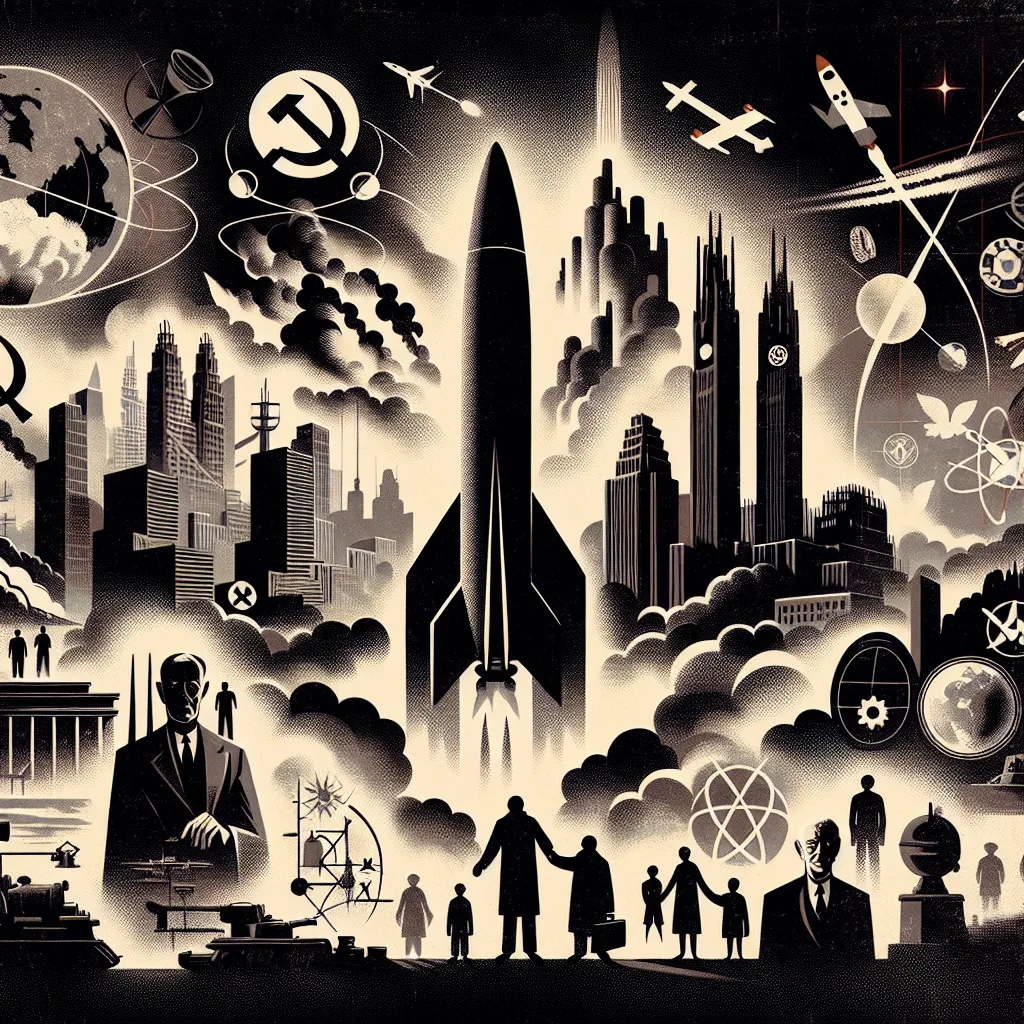
On August 6, 1945, the U.S. dropped an atomic bomb on Hiroshima, followed three days later by another on Nagasaki, showcasing the terrifying power of nuclear energy. Both cities were virtually erased, and their populations decimated. Out of World War II’s ashes, the U.S. and the Soviet Union emerged as superpowers, locking into a nuclear arms race. This period, especially after the 1950s, fueled a relentless push for technological superiority and unprecedented militarization.
The Cold War wasn’t just a clash of ideologies between capitalism and communism but also a quest for technological dominance. Each side aimed to outdo the other in scientific advancements, from weapon technology to space exploration. The space race and nuclear arms race pulled humanity to the brink of annihilation while driving decades of scientific breakthroughs that shape our modern world.
As the war raged on across Europe, it reached its darkest moments with the liberation of Auschwitz, Mussolini’s execution, and Hitler’s suicide. By May 1945, Germany fell, yet the conflict in the Pacific dragged on. Faced with Japan’s unwillingness to surrender, the Allies considered an invasion that could cost half a million lives. To avoid this, President Truman approved the use of a new weapon—the atomic bomb.
The Manhattan Project, spurred by Einstein’s 1939 letter warning of Germany’s atomic research, culminated on July 16, 1945, with the world’s first atomic bomb test in New Mexico. This “Gadget” unleashed a blast equal to 20,000 tons of TNT, signaling the dawn of the atomic age. Soon, Hiroshima and Nagasaki felt the devastating force of “Little Boy” and “Fat Man,” resulting in Japan’s surrender and the end of World War II. The atomic bomb’s massive destructive power, using fission from uranium-235 or plutonium-239, showed the world a terrifying new weapon.
The war’s end didn’t halt the technological arms race. The Soviet Union, having captured many German scientists, raced to develop its atomic bomb, culminating in the detonation of “First Lightning” in 1949. This breakthrough shattered the brief U.S. monopoly on nuclear weapons, igniting an intense race for nuclear supremacy.
The subsequent development of the hydrogen bomb, vastly more powerful than its atomic predecessors, pushed the arms race to new heights. By 1952, the U.S. tested such a bomb, while the Soviet Union followed suit in 1953. These developments, coupled with the progression towards intercontinental ballistic missiles (ICBMs), escalated the stakes, making rapid and vast nuclear retaliation feasible.
This technological emergent also intensified conflicts, as demonstrated by the Korean War, which marked the cold war’s ‘hot’ confrontations. A nuclear overhang loomed over these regional skirmishes, underscoring the perilous balance of terror defining the Cold War.
In the early stages of rocketry, the Soviet Union’s launch of Sputnik in 1957 stunned the world, revealing their significant technological might. The U.S. responded with its own achievements in missile technology, epitomized by the Minuteman missile, a solid-fueled ICBM capable of immediate launch from hidden silos, coming into prominence in the early 60s.
The Cuban Missile Crisis of 1962 brought the superpowers perilously close to nuclear war, underscoring the chilling doctrine of Mutually Assured Destruction (MAD). The crisis dissipated through tense diplomacy, but it etched the fear of nuclear annihilation deep into the global consciousness.
In the subsequent decades, arms control efforts like the Partial Test Ban Treaty (1963) emerged, aiming to curb the rampant nuclear testing that polluted the environment. Despite these efforts, countries like China, France, Israel, and North Korea pursued their nuclear programs, driven by regional security concerns and international power dynamics.
Catastrophes like the Three Mile Island incident in 1979 and the Chernobyl disaster in 1986 exposed the perils of nuclear technology, further influencing public and political attitudes towards nuclear power and weapons.
The end of the Cold War saw a reduction in nuclear arsenals, yet the legacy of this era continues to shape international relations. The pursuit of nuclear energy also offered a glimpse of its potential as a clean energy source, despite the inherent risks demonstrated by past accidents.
At its core, the nuclear arms race underscored a fundamental certainty: in the atomic age, mutual destruction would be suicidal. Thus, humanity must continually strive to avoid this fate, learning from the technological leaps and boundless perils of the past.