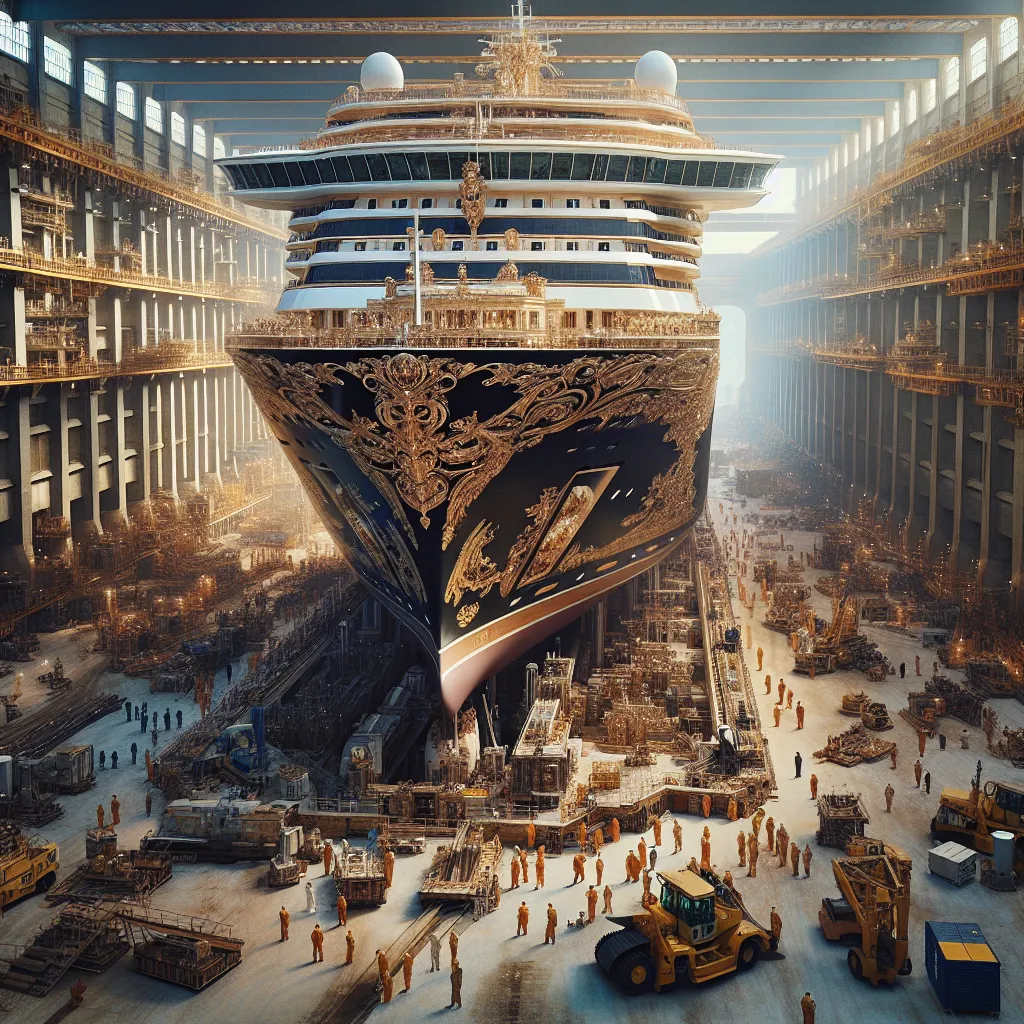
A team of pioneering shipbuilders is racing to build the ultimate cruise ship, a super-liner costing £360 million. They aim to create something more opulent than the Titanic, a true one-of-a-kind luxury vessel. The goal: attract the world’s richest travelers with suites priced as high as £8,000 a night. The stakes are incredibly high, filled with risks and rewards, much like upgrading from building Chevrolets to crafting a Rolls-Royce.
Constructing this vessel isn’t just about opulence; it’s an engineering marvel. Hundreds of passengers need to be kept safe while sailing far from shore through violent storms and rough waters. The team must blend time-honored traditions with groundbreaking technology, ensuring they meet their tight deadlines and safety regulations.
The new ship, being built in Genoa, Italy, is set to redefine luxury cruising. The process starts with attaching rare coins to the hull for good luck and receiving a blessing from a priest. Italian engineers, with a long history of shipbuilding, face unprecedented challenges to create this marvel.
Over the last 25 years, the worldwide cruise market has exploded, growing from under 4 million passengers a year to over 22 million today, now a £32 billion a year industry. However, competition is fierce, and to stand out, companies are building larger and more affordable vessels. But one cruise company and its CEO, Frank Del Rio, have chosen a different path, opting for luxury over size. Their new ship, The Seven Seas Explorer, will feature crystal chandeliers, acres of marble, and custom-designed settings, with suites averaging £10,000 per 2-week cruise.
While the ship will hold just 750 passengers, their expectations will be sky-high, accommodated in 374 suites, including a 400 sq m penthouse at £8,000 a night. This ambitious project is not just a business endeavor but a complex engineering challenge. Luxury is heavy, and the ship’s marble and glass fittings will require innovative solutions to maintain stability.
In Italy, engineer Pier Luigi Punter is tasked with delivering the ship on schedule. Thousands of people are involved, but he coordinates all activities from design to delivery. Missing the deadline could cost millions and tarnish the company’s reputation.
To speed up construction, Pier Luigi has devised an innovative approach. They will build the ship piece by piece in a dry dock, installing engines and machinery as they go. Meanwhile, another section of the ship is being assembled 400 km away, ensuring that both parts fit perfectly when joined. This technique will cut eight weeks off the construction timeline.
The ship’s interior will be another major undertaking. CEO Frank Del Rio is on a mission to source artwork to adorn the vessel, a task that demands thousands of pieces, including those for public bathrooms. The artwork budget of £7 million is unprecedented for a vessel.
To ensure passenger comfort, engineers must minimize vibrations by designing special propellers. These are cast from bronze and require extreme precision to avoid flaws that could cause discomfort. And the weight must be managed carefully, especially for the most extravagant suites located high up on the ship. Decadent features like stone floors and marble walls mean weight must be intelligently distributed to avoid instability.
With the ship now taking shape in Genoa, workers race to complete the internal fittings within nine months. Everything, from electrical systems to luxurious finishes, must be meticulously installed and tested in a series of critical sea trials before the ship can welcome its first passengers.
As the countdown to the maiden voyage begins, the pressure mounts. Designers, carpenters, and decorators are working around the clock to transform the steel shell into a floating masterpiece. With everything on the line, the final phase of installations will determine if this ambitious project will meet its grand promise.