The Fermi Paradox Explained: 5 Mind-Bending Theories About Why We Haven't Found Aliens Yet
Explore the Fermi Paradox: Why haven't we found aliens despite billions of stars? Discover Great Filter, Zoo Hypothesis, and other theories explaining cosmic silence.
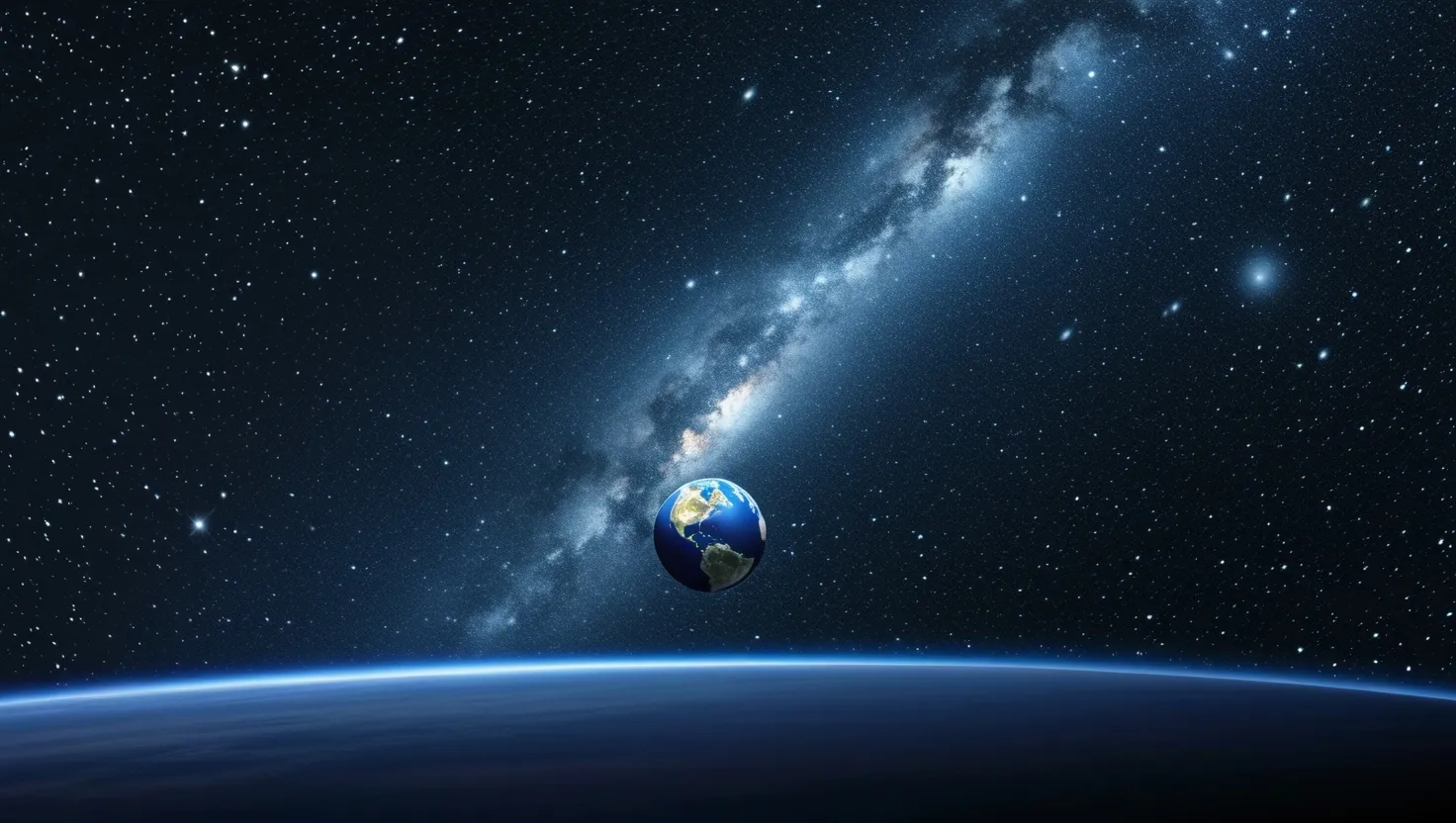
If you’ve ever gazed up at the night sky and wondered if we’re alone, you’re not being naive—you’re acting on one of the most enduring and baffling questions in all of science. The basic math is, at its heart, both optimistic and haunting: with billions of stars in our galaxy alone, and untold billions of galaxies beyond, the odds of life arising elsewhere should be staggeringly high. Yet in all the centuries of looking, listening, and probing, we’ve heard nothing but the echo of our own curiosity. This contradiction is known as the Fermi Paradox—a mystery that seems to sharpen every time our instruments get better or our minds reach further. Where is everybody?
I find it helpful, when wrestling with such a question, to lay out the best ideas people have proposed. But let’s not linger on the familiar. You already know about UFO sightings and sci-fi tropes. Instead, I want to guide you through a handful of the more intriguing and unconventional explanations. These are the ones that keep astrophysicists awake at night and challenge everything we think we know about the universe—and ourselves.
We’ll start with a notion that’s both chilling and oddly flattering: the Great Filter Hypothesis. Imagine that the universe is dotted with barriers—events or conditions so unlikely or catastrophic that few, if any, civilizations can ever pass through them. Maybe life is easy to start, but almost impossible to evolve beyond microbes. Or maybe intelligent life is common, but almost every civilization snuffs itself out with technology before it can reach the stars. The kicker? We don’t know if the biggest filter is behind us, or lying in wait. Are we rare survivors—or doomed to fail, just like all the others might have?
As Nick Bostrom put it:
“No news is good news. It suggests we may have already passed the Great Filter.”
That idea can leave you with a sense of cosmic trepidation. But there’s another possibility that’s almost playful by comparison: the Zoo Hypothesis. You’ve probably visited a zoo, watched animals pace their enclosures, and pondered what they might think of the strange creatures peering at them through glass. Some scientists suggest something similar might be happening on a galactic scale. Maybe advanced civilizations are aware of us, but choose not to make contact, treating Earth as a kind of cosmic nature reserve. They might be waiting for us to reach a certain level of maturity, or perhaps they simply want to avoid disrupting our development. In a twist on this idea, the so-called Planetarium Hypothesis posits that our reality is carefully managed—or even simulated—by entities that wish to control what we perceive. If this sounds far-fetched, ask yourself: If you were part of a vastly more sophisticated civilization, how might you treat a newly eavesdropping world?
This raises a provocative question: If aliens are out there, is it arrogant—or cautious—for them to avoid us? Would we recognize an attempt at contact even if it happened?
But let’s not stop at galactic etiquette. Consider the Transcension Hypothesis. It takes our usual vision of technological progress—spaceships, giant radio dishes, sweeping interstellar empires—and replaces it with something subtler but far stranger. What if, once a civilization reaches a certain threshold, it stops seeking expansion and instead focuses inward? It might optimize its existence by uploading minds into digital forms, manipulating matter and energy in ways that don’t produce signals we could detect. Maybe the greatest achievements are hidden in the manipulation of quantum scales, the creation of black-hole computers, or the engineering of realities invisible to us. From our perspective, they would simply vanish, leaving no trace in the electromagnetic spectrum.
As Arthur C. Clarke once famously observed:
“Any sufficiently advanced technology is indistinguishable from magic.”
So, could we be looking for magic with the wrong set of tools?
Then comes what I think of as the ultimate act of cosmic humility: the Rare Earth Hypothesis. For all our sense of being average—one planet, circling an ordinary star, in a generic galaxy—what if we’re anything but typical? The more we learn about exoplanets, the more we realize just how many things had to go right for complex life to blossom here. A planet at just the right distance from a stable sun. A protective Jupiter-like neighbor to sweep away deadly asteroids. Plate tectonics to recycle nutrients. A large moon to stabilize our climate. Each might seem trivial, but together they make Earth a statistical outlier on a cosmic scale.
You might ask: Are we simply the lucky exception, a cosmic fluke? And if so, does that make our silence less mysterious, or more precious?
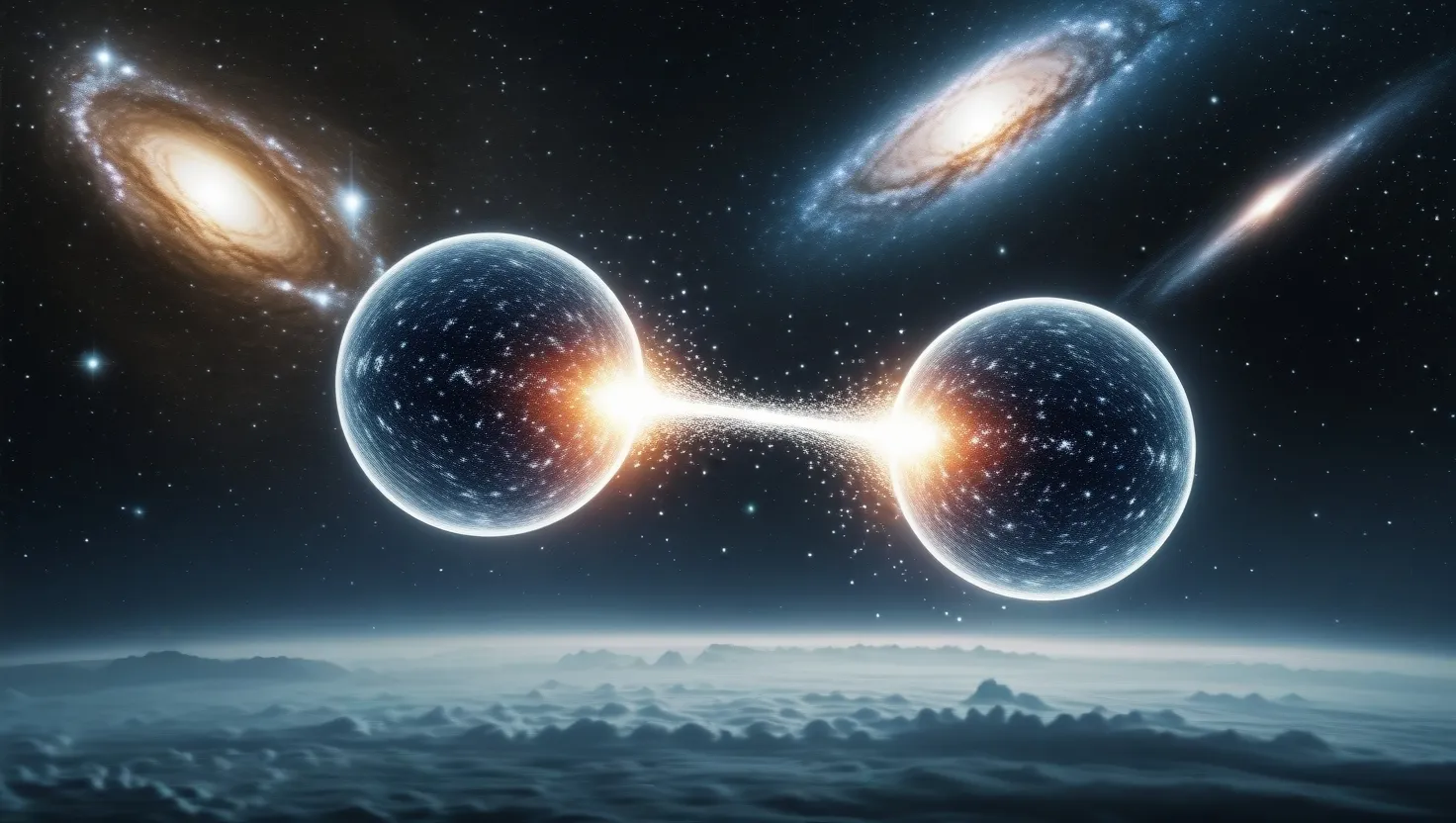
Finally, let’s question whether the problem is with our ears, not the silence. Our search for aliens is shaped by our own limited perspective—we listen to particular frequencies, at specific times, expecting the universe to shout back in the same ways we would. But what if communications don’t work like that? Civilizations might use methods we haven’t imagined, like quantum entanglement or undetectable particles such as neutrinos. Or perhaps their presence is defined by timescales that dwarf our own: civilizations might rise and fall in a flash, or endure for eons, missing us by cosmic seconds. Maybe we’re tuning into the wrong channel or simply arrived too late (or too soon) to catch the universal conversation.
Carl Sagan once mused:
“Absence of evidence is not evidence of absence.”
If you’re still with me, let’s pull back for a moment. Each of these explanations opens up unsettling possibilities: Maybe life is rare, maybe we’re quarantined for our own good, maybe others are unrecognizably advanced, maybe we’re unique, or maybe we’re just not searching the right way—or at the right time. Each idea carries a kind of existential weight.
But why should this puzzle matter to us? For me, the paradox is less about the prospect of alien neighbors and more about how we see ourselves. Are we a brief anomaly, a lucky draw, or the latest in a long line of failures? Are we ready, culturally and technologically, to respond to a signal—if it ever comes? Would such a discovery unite us, or push us further apart?
Maybe the most useful question isn’t about where everyone is, but whether we’re asking the right questions. The Fermi Paradox isn’t just a riddle about outer space. It’s a mirror for our assumptions, our hopes, and our fears. As we push our telescopes further and send probes deeper, we’re really reaching out for an answer to the most fundamental of all questions: What does it mean to be a conscious, curious being in a universe that so far answers only with silence?
If I could leave you with a prompt, it’s this: How do you think we would react—to discovery, to contact, to evidence that we are not alone? Would it solve the riddle, or only deepen it? Sometimes, it seems, the questions we ask tell us more than the answers we find.
“Two possibilities exist: either we are alone in the Universe or we are not. Both are equally terrifying.” —Arthur C. Clarke
As I see it, any outcome—contact, silence, or something we can’t yet imagine—is a reminder of how vast the unknown remains. It’s the unknown that keeps us hungry, keeps us searching, and maybe, just maybe, keeps us hopeful.