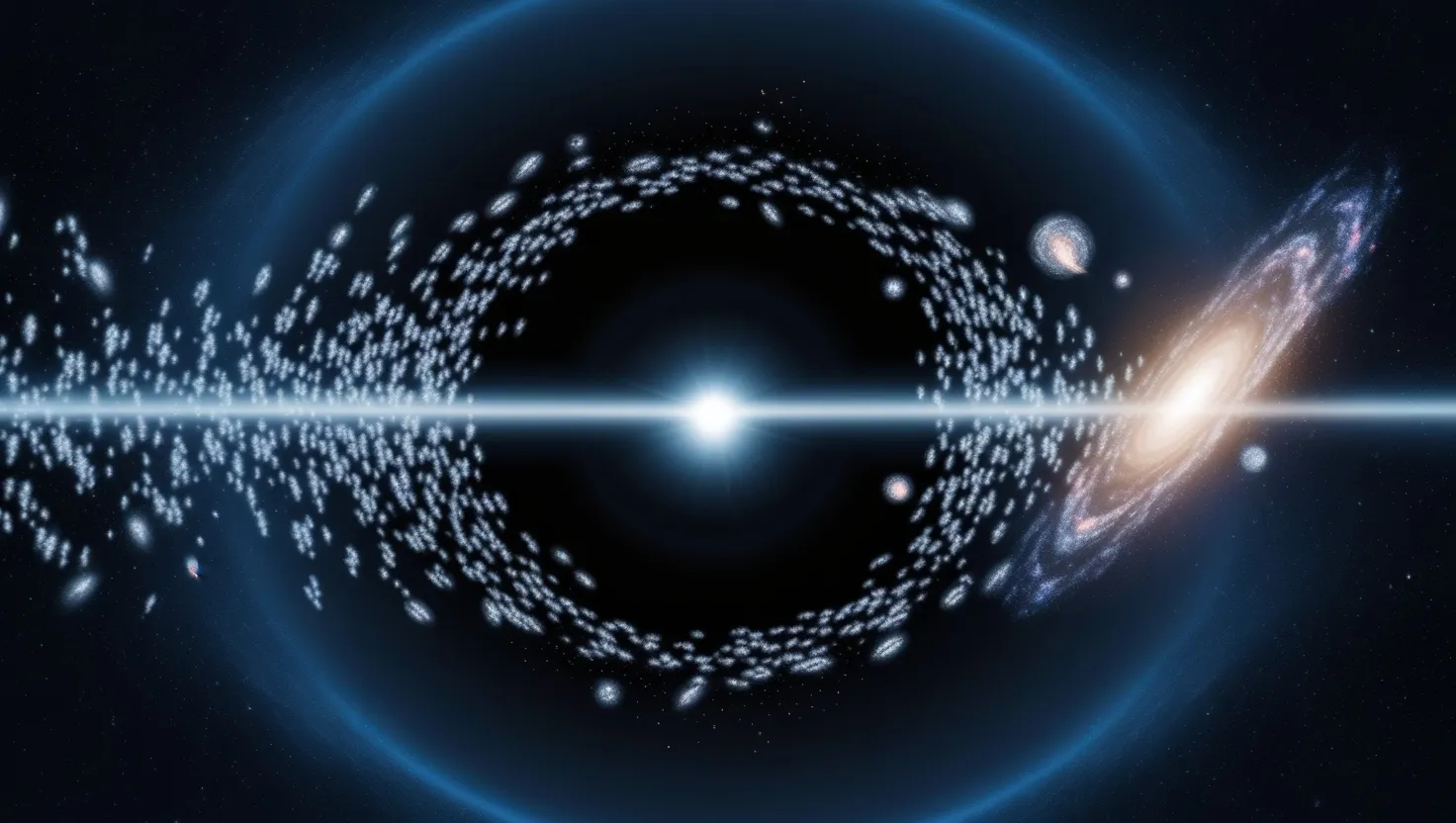
Unlocking the Universe: The Mind-Bending Magic of Quantum Entanglement
Quantum entanglement connects distant particles, reshaping technology, challenging reality concepts, and fueling advancements in quantum computing and secure communications.

Imagine a universe where two particles can connect in such an intricate dance that, no matter how far apart they are, they can still influence each other’s state. This isn’t science fiction; it’s the spellbinding reality of quantum entanglement, a phenomenon that takes center stage in the world of quantum mechanics. It’s baffled great minds and sparked countless debates because it challenges the very way we understand space and time.
At the heart of quantum entanglement, we’re dealing with an oddity where particles become so interlinked that the state of one instantly mirrors or impacts the state of another, defying distance. It’s like a cosmic whisper shared between two particles across the universe. This mind-bending concept was first spotlighted by legends like Albert Einstein, who, despite being skeptical, had to grapple with its implications. He called it “spooky action at a distance,” not out of fear but due to its perplexing nature.
Originally thought of as a curiosity, scientists have since embraced entanglement as a cornerstone of quantum mechanics. Imagine two entangled photons: tweak one, and instantly, the other responds identically, no matter how remote it is. At first, it might sound like magic, but it’s a reality borne out through meticulous experiments, with a landmark one taking place as early as 1949, confirming that entanglement wasn’t a mere theory.
The real excitement, though, comes from the endless possibilities this brings. We’re not just talking about mind-boggling scientific trivia. Entanglement could reshape technology as we know it. It’s critical to the dreams of creating quantum computers that leave today’s fastest machines in the dust. Picture this: where a classical computer bit is either a 0 or a 1, a quantum bit, or qubit, can be both simultaneously. It’s like having your cake and eating it too, which means processing data in ways we haven’t even dared to dream.
But wait, it gets wilder. Not long ago, some clever folks at Princeton tangled individual molecules together for the first time. Molecules! We’re opening the door to a brand-new playground for the future of quantum technology, using these entangled molecules as building blocks for even more advanced breakthroughs. Think about it: using a series of microwave pulses, they encouraged these molecules to interact in perfect synchrony, paving the way for the next generation of quantum computing.
And that’s where the notion of “quantum advantage” kicks in. It’s a fancy term for the sheer power quantum devices have over classical ones. By embracing the quirks of quantum mechanics, these devices execute tasks that would leave ordinary computers scratching their heads. Quantum simulators, for instance, delve into the behaviors of complex materials, offering insights beyond classical interpretation.
Entanglement isn’t just about physics; it also wades into philosophical waters. It nudges us to reconsider how we perceive reality, causality, and even free will. If particles millions of light-years apart are essentially in sync, what does that say about our universe? Does distance even matter in the overarching scheme of things? These are the questions that keep philosophers and scientists awake at night, debating the very fabric of existence.
There’s a beautifully bizarre connection here between quantum entanglement and topology—the study of geometric properties and spatial relations unaffected by continuous changes. Researchers are tapping into how entangled particles maintain shared attributes despite disruptions, pointing out a deep-rooted link between how these particles behave and their topological nature. It’s an intricate dance of science and theory that could unravel future mysteries of entangled systems.
Taking a closer look into practical applications, entanglement isn’t trapped in the realm of theoretical physics. Quantum key distribution, a method explored by pioneers like Charles Bennett, utilizes entanglement for secure communications. It cleverly ensures that any interception attempt would set off alarms, revolutionizing how we maintain privacy in our digital age.
Then there’s the magic of quantum imaging, a technique that lets scientists capture images using photons that haven’t even touched the object involved, thanks to their entanglement with photons that did. This groundbreaking method shines bright in areas like biological or medical imaging, where working under minimal light is crucial.
As research accelerates, we’re only glimpsing the beginning of what these developments in quantum entanglement can offer. Each new discovery, from entangled molecules to topological breakthroughs, hints at uncharted possibilities. Quantum science is on a fast track, and every step forward seems to promise something even more revolutionary on the horizon.
Navigating this quantum landscape can be perplexing, no doubt. Most rules fly in the face of classical intuition, making concepts like entanglement feel otherworldly. Yet, it’s these very principles that redefine our understanding of how the universe ticks. Exploring these depths doesn’t just challenge perceptions; it expands them, offering a fresh, thrilling perspective on the cosmos itself.
In wrapping up, quantum entanglement isn’t just an obscure theory tucked away in textbooks. It’s a dynamic, evolving force beckoning us to redefine reality. It nudges us towards new questions, new theories, and perhaps, new truths. With each experiment and every theory tested, we stride closer to deciphering the enigmatic essence of our universe, one entangled particle at a time.