What Can the Death of Stars Teach Us About Our Own Cosmic Fate?
From Stellar Birth to Cosmic Dance: The Secret Life Cycle of Stars Unfolded
Stars are born, they grow, and eventually, they die. But what happens in the end? Do they fade away quietly or explode dramatically? Somewhere between our world and the edge of the universe lies the intriguing answer.
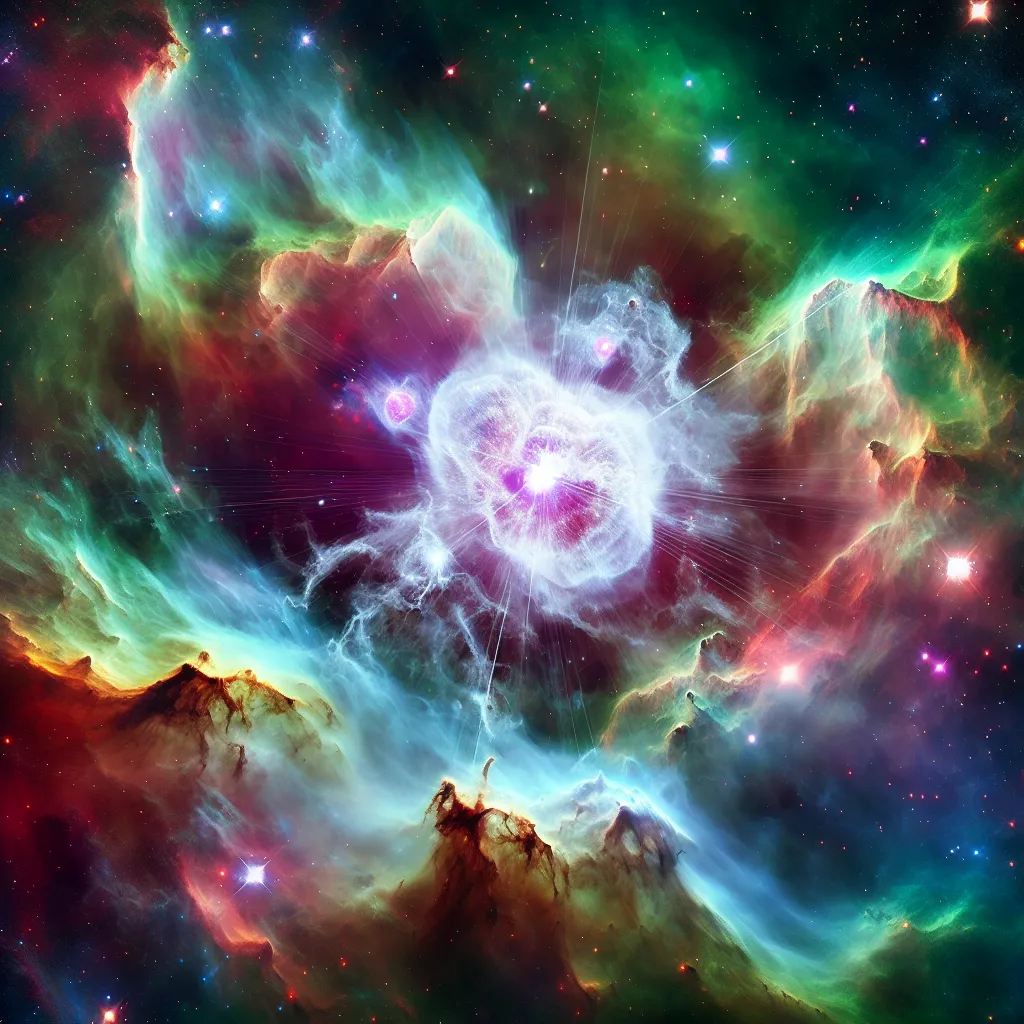
Imagine being 4,000 light years away, where luminous clouds hang in space, circling what was once a star like our own Sun. What’s left are brightly colored gases, elements forged by nuclear fusion deep within the star. These gases—green and violet hydrogen, and helium—are the raw materials of the cosmos. Red and blue nitrogen and oxygen are our building blocks of life on Earth. For us to exist, stars had to die, creating the oxygen we breathe and the nitrogen in our DNA. Essentially, we are made from stellar nuclear waste.
In the heart of these cosmic remains, there’s the ghost of a star—a white dwarf. White-hot and small, but so incredibly dense that a mere teaspoonful would weigh one ton. This chilling remnant is a snapshot of our Sun’s future. In about 6 billion years, our Sun will become a white dwarf too, marking the end of life on Earth. It’s humbling to think about how many other worlds have lived and died, their stories lost to time and space.
But the greatest tale is yet untold. To truly understand, we must journey back to the very beginning. The remains of a dead star, the Crab Nebula, tell part of this story. We are 6,000 light years away, deep within a stellar graveyard.
We’ve learned much and seen wonders we never thought possible. Now, even sights like this, once beyond imagination, are within our grasp. We stand ready to explore further, aiming to reach the edge of the universe. The scene might look calm now, but it’s the aftermath of a supernova, an explosion so powerful it turns a massive star into a cloud of dust and gas.
At the eye of this storm is a pulsar—a spinning, pulsating star core compressed to a mere 20 kilometers across. Its density is unimaginable, with just a pinhead of material weighing hundreds of thousands, if not millions, of tons. Like a figure skater pulling in their arms to spin faster, this pulsar accelerates rapidly, emitting beams of light and radiation that spin 30 times a second. These beams power the surrounding cloud of dust and gas, creating a radiation field even more intense than the Sun’s.
This celestial dance of life and death is a powerful reminder of our place in the universe, encouraging us to explore further and uncover the myriad stories of the stars.