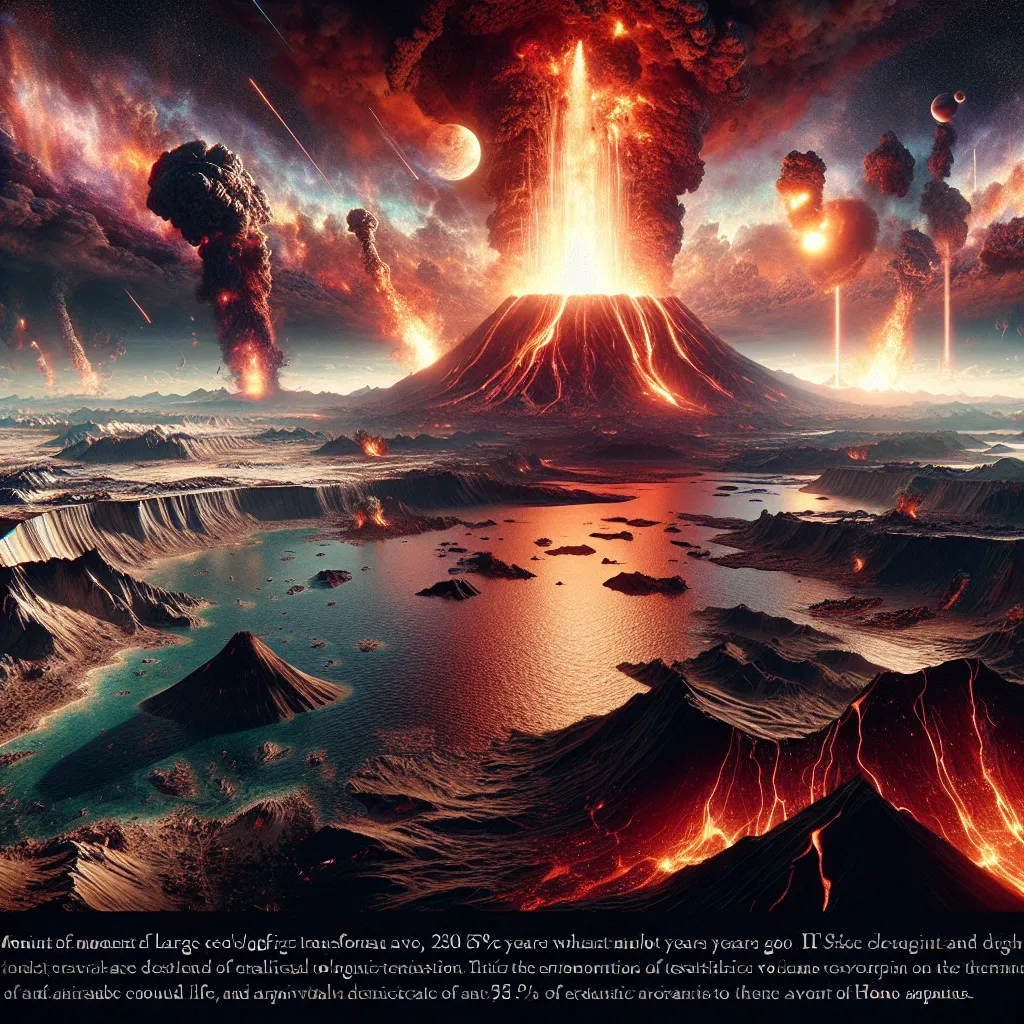
Since the Earth was formed billions of years ago, it’s seen one disaster after another. Around 250 million years ago, a massive volcanic eruption nearly wiped out all life on Earth. This catastrophic event, known as the end-Permian Extinction, was the most devastating in our planet’s history. Yet, without it, humans wouldn’t exist today.
Imagine Earth’s entire history squeezed into a single day. By 10:40 PM, representing that mass extinction, nearly everything was on the brink of annihilation. Over 95% of species, both on land and in the sea, vanished in a relatively short time. This dramatic die-off reset the evolutionary clock, creating a new environment in which future life, including humans, could evolve.
So, what caused this unparalleled disaster? Paleontologists and geologists have been hunting for clues for decades. In South Africa’s Karoo Basin, scientists found that the area was once lush and filled with life, but something wiped it all out. Layers of sedimentary rock tell a story of sudden and severe climate change, showing a switch from wet, green environments to arid, red ones. This global spike in temperature killed off the planet’s life forms, leaving nearly nothing behind.
Initially, scientists speculated that an asteroid might have been responsible, much like the one that ended the reign of the dinosaurs. However, studies showed that the extinction unfolded over 100,000 years, far too long for an asteroid event. The culprit, it turns out, was deep beneath the Earth’s surface—volcanic eruptions.
These weren’t just any eruptions. In what is now Siberia, a catastrophic series of volcanic events called the Siberian Traps spewed vast amounts of lava and noxious gases. This flood basalt could have covered an area the size of the United States under a mile of molten rock. The consequences were severe. Sulfur dioxide released by the eruptions caused acid rain and temporary global cooling, followed by a release of carbon dioxide that pushed temperatures higher than the planet could handle.
As temperatures rose, the Earth’s oceans started to stagnate. This halted the circulation of oxygen, essentially suffocating marine life. Hydrogen sulfide, a poisonous gas produced by bacteria in low-oxygen environments, began seeping into the oceans, turning them into deadly zones for most aquatic life. Soon, life in the sea faced its own extinction crisis, adding to the woes on land.
The final nail in the coffin came from methane hydrates, frozen methane stored at the bottom of oceans. When global temperatures increased sufficiently, these hydrates thawed, releasing methane—a greenhouse gas far more potent than carbon dioxide. This caused another jump in global temperature by about 10°F, exterminating nearly all remaining life forms.
Yet, these catastrophic events set the stage for new life. With most dominant species gone, newly adapted organisms had room to thrive. One such survivor was a small, burrowing animal called Thrinaxodon, who lived by hiding underground. These creatures soon became the ancestors of mammals, including humans. Our very existence hinges on their survival through this dire period.
Today, Earth’s stability faces a new threat—us. Human activities release large amounts of carbon dioxide, mimicking the conditions that triggered the end-Permian Extinction. If we continue, we may set off another catastrophic chain reaction, impacting life on a global scale.
So, the story of Earth’s past mass extinction serves both as a grim reminder of nature’s power and a cautionary tale for our future. While life rebounded back then, the ecological balance tipping once more could spell a challenging future for all species, including us.