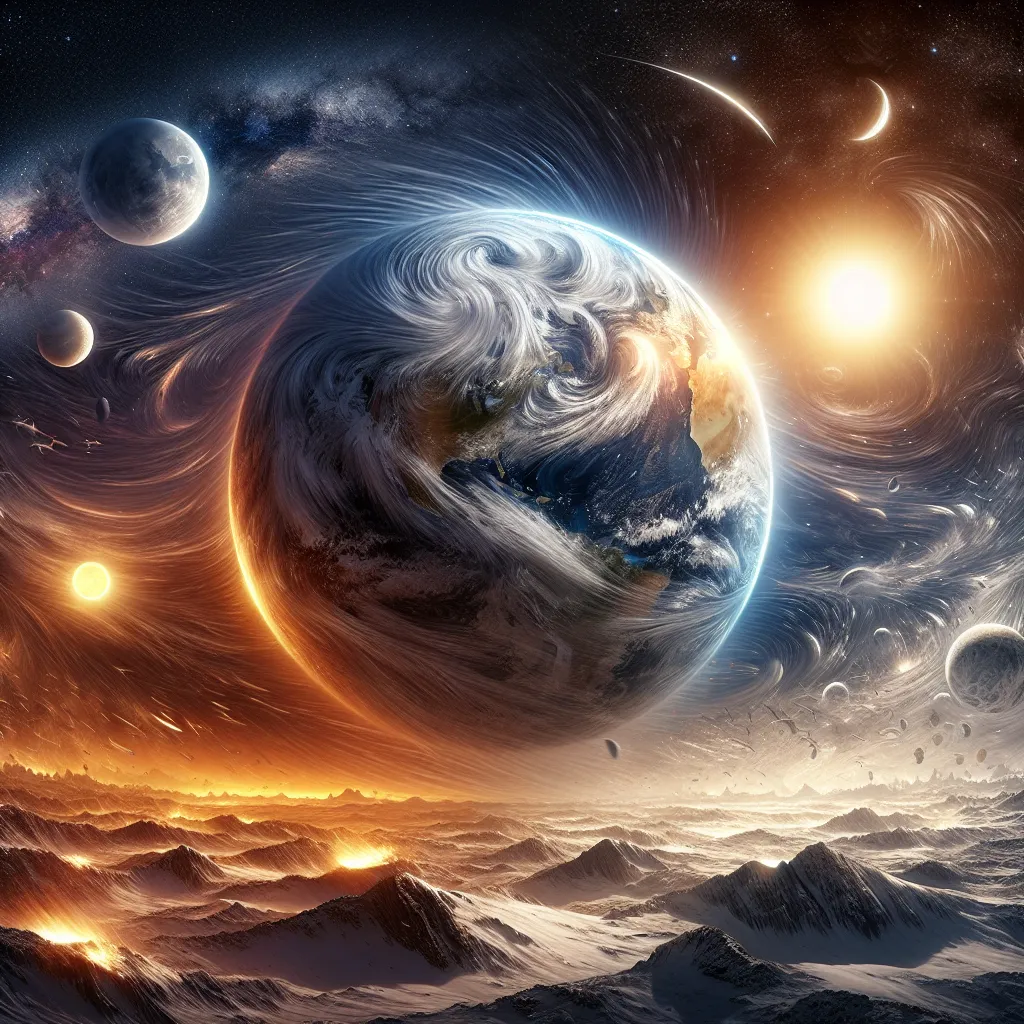
Imagine a world plagued by hurricane-force winds, swinging from blistering heat to freezing cold, with days that last only six hours. This could be the reality if Earth had no moon. Our celestial companion, a 81-million-billion-ton rock orbiting nearly 250,000 miles away, plays a crucial role in creating the life-sustaining environment we often take for granted.
The moon isn’t just some silent, romantic orb; it’s a bartender in the grand pub of cosmic mechanics, blending gravity and stability into Earth’s perfect cocktail. Without the moon, Earth would experience chaos in its axial tilt, throwing our weather systems into disarray and potentially swapping tropical warmth for frozen wastelands. Yet, the moon’s influence extends far beyond that of a simple stabilizer. It has helped calm Earth’s initially frenetic spin, lengthening our days from a dizzying six hours to a more manageable 24.
Over 4.5 billion years ago, an enormous collision between Earth and a Mars-sized body named Theia created our moon. This fiery birth altered Earth’s rotation, setting it on its much-needed tilt. The aftermath formed a ring of debris around Earth that eventually coalesced into our moon. As it formed, it drifted away from Earth at a rate of 1.5 inches per year, a journey marked by a reflective plate left by astronauts in 1969 that helped modern scientists confirm its steady drift.
Asteroids and other celestial impacts gave the moon its cratered face and dark basaltic maria, shaping the “man in the moon” we often picture. This bombardment, particularly during the so-called “lunar cataclysm,” also showered Earth with meteorites, possibly seeding our planet with crucial ingredients for life. The process of tidal friction, where the moon’s gravity causes the Earth’s oceans to ebb and flow, could have been the catalyst for life’s primordial soup, mixing nutrients in ways that sparked complex chemical reactions.
The moon didn’t just calm Earth’s youthful storms and give our primordial soup a good stir; it molded the very rhythm of life. High tides powered by lunar gravity may also have helped the development of DNA, setting the stage for life as we know it. These tides not only smoothed out our atmosphere’s tempests but also lengthened our day from a frantic six hours to a leisurely 24, making Earth more habitable for evolving life forms.
Today’s moon might seem less influential, but its gravitational string-pulling still has profound effects. Some scientists link it to natural events like volcanic eruptions and even earthquakes, albeit controversially. Yet, the idea that the full moon turns humans into lunacy-prone creatures might be more myth than reality, perpetuated by lore and horror tales.
As the moon drifts ever so slightly away from us, its stabilizing influence wanes. Eons from now, it might settle into a more distant orbit, losing its grip on Earth’s axial dance and making our planet’s climate unpredictable. In five billion years, both Earth and moon might face the dying throes of the sun together, engulfed in a final fiery embrace.
The moon is more than a night-time spectacle; it’s the unseen hand that shapes our world in ways both subtle and spectacular. From creating tides to stabilizing our planet, its impact is as deep as the craters dotting its surface. We owe much of what we cherish about Earth to our steadfast lunar companion.