Why Are We Alone? Exploring Five Mind-Bending Aspects of the Fermi Paradox
Explore the Fermi Paradox: Why haven't we found alien life despite billions of planets? Discover the Great Silence, Zoo Hypothesis, and communication gaps that explain our cosmic solitude.
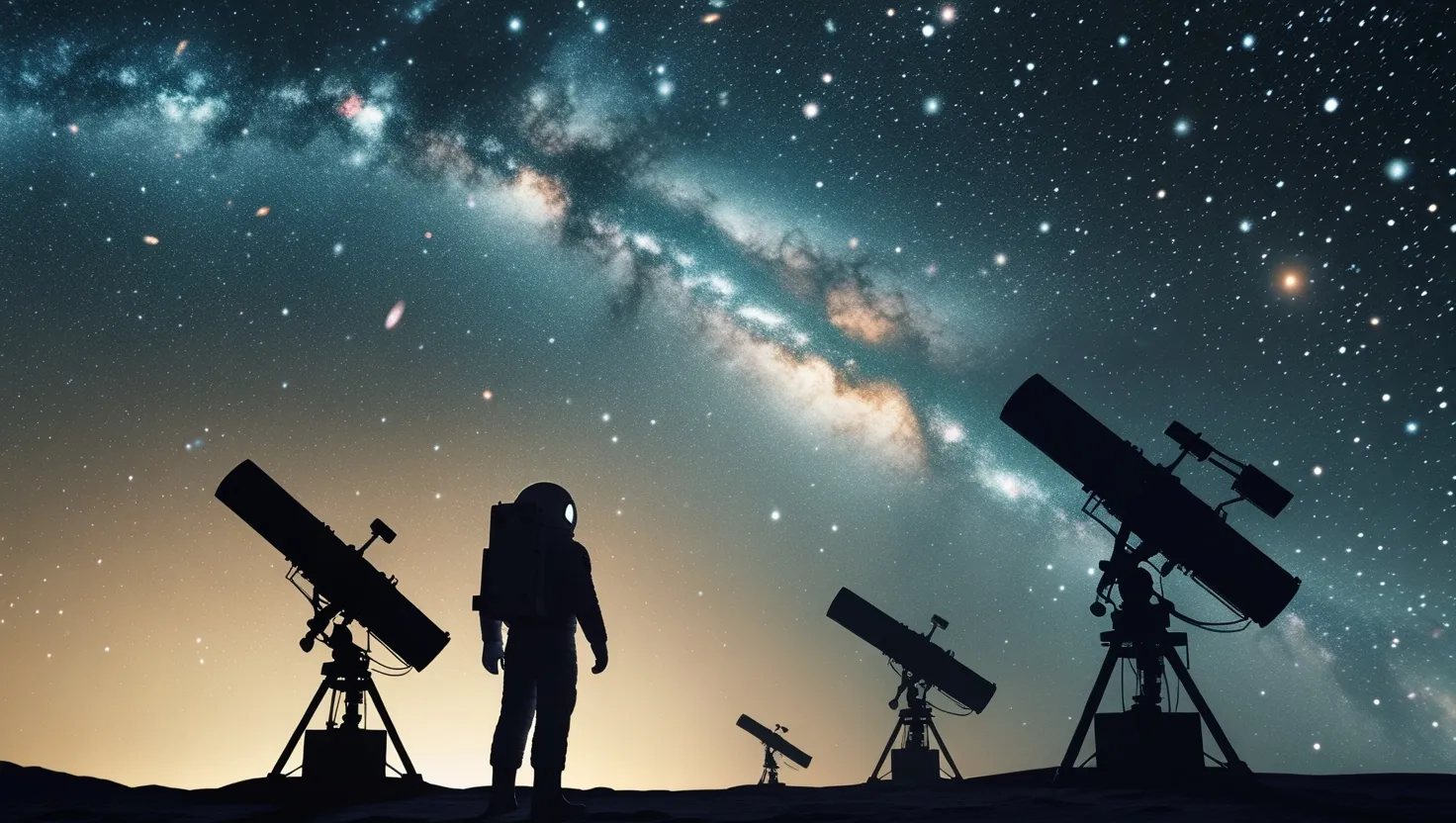
The Fermi Paradox sits at the center of one of humanity’s oldest, most persistent questions: If the universe is so vast, and planets like ours so abundant, why don’t we see any evidence of other intelligent life? As I reflect on this question, I can’t help but feel both awe and frustration. We stand on a quiet balcony in a universe that should be full of noise. Yet, the silence prevails.
When Enrico Fermi blurted out his famous question—“Where is everybody?”—over lunch in 1950, he may not have realized he was summarizing a paradox that would baffle generations of thinkers, from astrophysicists to philosophers. I find this puzzle only deepens as we learn more about the cosmos. Exploring five of its most baffling aspects, let’s peel back some layers and ask: why is the universe, with all its apparent opportunities for life, still mute?
I first want to highlight what’s often called the “Great Silence.” We know the numbers are staggering. There are hundreds of billions of stars in our galaxy alone, with even more planets, many in zones where life could thrive. Yet, after decades of signals sweeping across the sky—searching for even a whisper of intelligence—we’ve found nothing. Why, with more planets than grains of sand on Earth’s beaches, do we sit alone in the dark, headphones on, hoping for a cosmic hello? Is silence the true voice of the cosmos, or are we simply not listening the right way?
“If we are alone in the Universe, it sure seems like an awful waste of space.”
— Carl Sagan
One angle that rarely gets enough attention is that the absence of evidence is not the evidence of absence. It’s easy to think the Great Silence means there’s no one “out there,” but silence could have many reasons. Perhaps other civilizations are not interested in talking. Or they could be emitting signals we can’t detect. I often question our bias: is it possible that life exists everywhere, but most forms explode and fade quickly, or grow so advanced they become invisible to our clumsy instruments? Maybe we’re like ancient mariners, shouting across the oceans, missing the subtle flickers of distant lanterns.
This takes me to an idea as strange as it is compelling—the “Zoo Hypothesis.” What if advanced civilizations are aware of us and choose to keep silent, even hiding their presence, like zookeepers avoiding direct interaction to prevent disruption? On its face, it feels too conspiratorial. Yet, think about how humans study wildlife. Biologists go to great lengths to avoid interfering with animals, recognizing observation can alter natural behavior. Could something similar be happening on a cosmic scale?
This proposal stirs a flood of questions for me. How could separate civilizations, scattered across galaxies, agree to a non-interference pact? And why would they all keep quiet, with not a single rebel or accidental “leak”? Galaxy-wide coordination feels improbable over the immense time and distance involved. But perhaps what I find more strange: what values or events drive a civilization to hide, rather than to explore and connect?
“Two possibilities exist: either we are alone in the Universe or we are not. Both are equally terrifying.”
— Arthur C. Clarke
Let’s consider time. The Cosmic Time Scale Problem is rarely discussed outside scientific circles, but it might be key. Imagine civilizations popping in and out across billions of years. Their windows of technological activity might be just tiny flashes. Are we simply out of sync—too early, too late, or even just blinking at the wrong moment? Sometimes I imagine civilizations blazing with energy, building wonders, then fading, wiped out by catastrophe or their own choices. Maybe intelligent life is as ephemeral as a shooting star—stunning, but brief.
This perspective makes our standard search methods seem almost laughably optimistic. Picture trying to catch all traffic on a highway by looking outside your window for a single second. That’s the scale of the problem. My mind keeps returning to the staggering odds against two intelligent species overlapping in place and in time, and both wanting to communicate, and both using the same methods. The real question becomes: how narrow is our window, and have we already missed the cosmic equivalent of a party invitation?
But what if our assumptions about how to listen are terribly flawed? The Communication Gap is arguably the most under-appreciated barrier. We look for radio waves and brief bursts in the electromagnetic spectrum—technologies that have dominated human communication for barely a century. Why should we expect other civilizations to use similar methods, broadcasting their existence across lightyears in a way we’ll notice, in the tiny blip of time we’re listening?
“For millions of years, mankind lived just like the animals. Then something happened which unleashed the power of our imagination. We learned to talk.”
— Stephen Hawking
Think about how quickly communication technologies have shifted, even just on Earth. Morse code, radio, analog TV—all obsolete in a few generations. In a galactic context, such methods are barely more than a spark in the dark. Could aliens communicate in ways we don’t understand—using quantum entanglement, gravity waves, or technologies indistinguishable from magic? If so, extraterrestrial intelligence might be screaming, but we’re simply deaf to their language.
Sometimes I wonder, are we like birds listening for whale songs beneath the ocean, frustrated by the silence, unaware of the medium and message? Perhaps the silence is not an absence of life, but an artifact of how we search, blinded by our technological limitations and assumptions.
New discoveries only deepen the paradox. Let’s suppose tomorrow we find simple life—bacteria on Mars, or plankton beneath Europa’s ice. That would be a seismic moment, showing that life does emerge where conditions allow. If simple life is common, why not intelligence? Does something immense block the road from microbe to mind? Maybe civilizations nearly always self-destruct. Or perhaps, complexity hit a wall unique to Earth.
This is the heart of what keeps me thinking: with every discovery of a new exoplanet or ancient microbe, the paradox sharpens, not fades. Each step closer to finding life elsewhere raises the stakes. If life is everywhere, why aren’t minds?
Here’s something that seldom gets asked: Could our silence be self-imposed? Some thinkers speculate it might be prudent for young species to stay quiet, avoiding attention from potential dangers lurking in the dark. What if the galaxy isn’t empty, but filled with quiet listeners, all following an unwritten code: don’t broadcast, just in case predators are listening? When I consider this unsettling prospect, I see a universe full of life, yet paralyzed by caution.
“To confine our attention to terrestrial matters would be to limit the human spirit.”
— Stephen Hawking
But what of our own future? Will our civilization grow noisier and more detectable, or retreat, focusing inward, making less of an imprint on the cosmos? The stories we tell ourselves—of noisy space empires and galactic federations—reflect our current stage, more than galactic realities. New models suggest that advanced civilizations may shrink their footprints, becoming energy efficient and virtually undetectable, choosing sustainability over expansion.
The Fermi Paradox also raises questions about our cosmic significance. Are we a fluke? Or is intelligence so rare that a single mind, anywhere, is priceless? I often ask myself: are we the first, the last, or just one among millions, all separated by an endless dark sea?
As I examine the vastness, I also wonder: does the paradox reveal more about our own expectations than the universe itself? Our search methods, our impatience, our hunger for contact—do they blind us to what is actually out there? The universe may hold forms and fates we’ve never even imagined. Perhaps the greatest lesson is humility.
“Somewhere, something incredible is waiting to be known.”
— Carl Sagan
Every time I gaze at the stars, the paradox lingers. The silence could be tragic, a testament to cosmic hazards or inevitable self-destruction. Or it might be brimming with promise, the quiet pause before a future chorus. It’s both unsettling and inspiring to dwell in not-knowing, to persist in the search, even as the questions deepen.
Where is everybody? Maybe the answer, when it comes, will surprise us all. Perhaps our cosmic loneliness is only temporary—a silence aching to be broken by a distant voice, or a chance encounter revealing we’re part of something immense. Until then, the Fermi Paradox remains not a statement of absence, but an invitation to expand our vision, and perhaps, our understanding of ourselves.