Why Time Doesn't Make Sense: The Physics and Psychology Behind Our Most Fundamental Mystery
Explore 5 mind-bending mysteries of time: from the arrow of time paradox to quantum granularity and consciousness. Discover why physics can't fully explain our most fundamental dimension of reality.
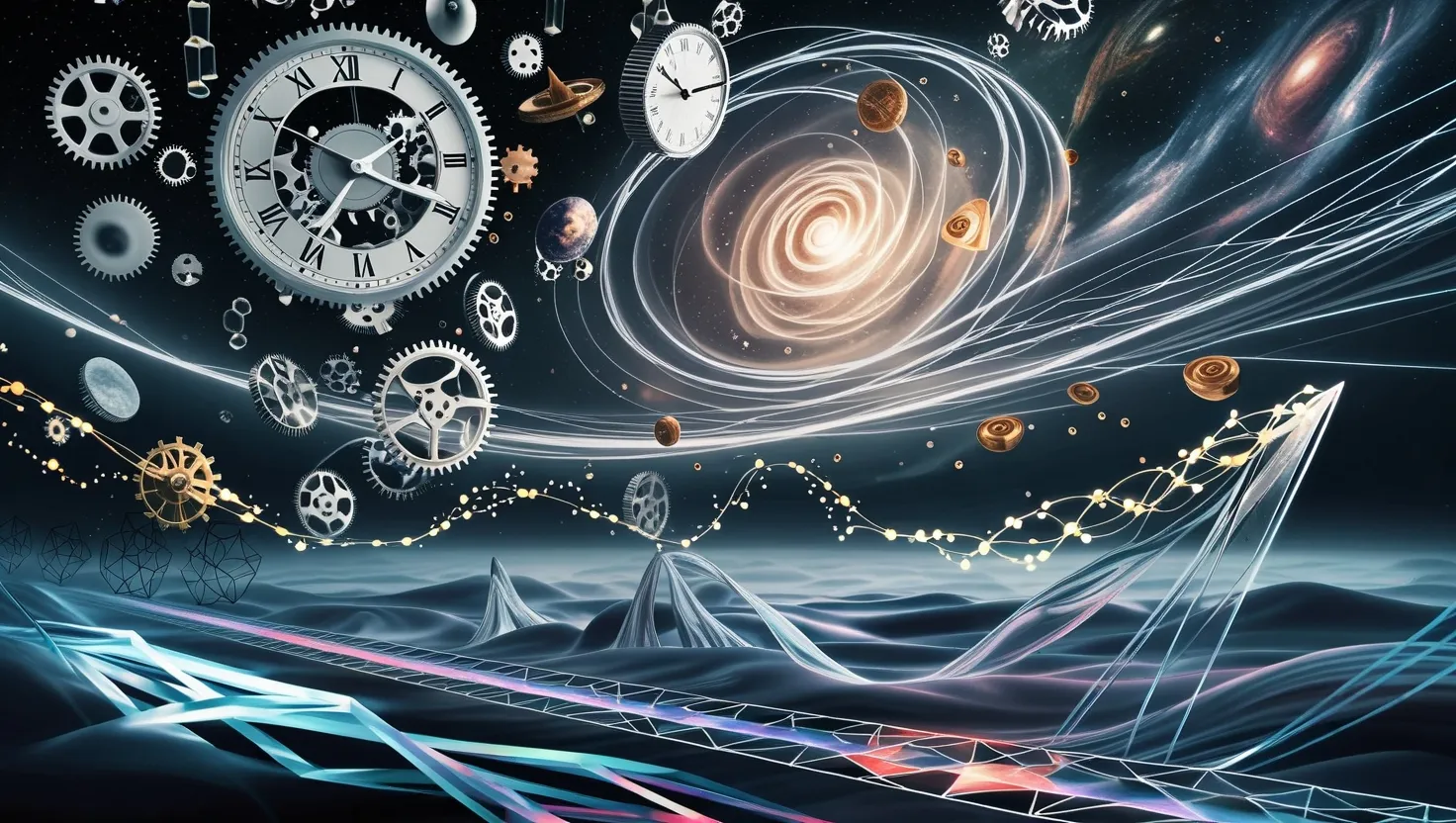
Time refuses to behave like we think it should. We measure it, schedule our lives around it, and yet when you really look at it, time turns out to be one of the most confounding aspects of existence. I’ve spent years thinking about these puzzles, and the more I learn, the more I realize how little we truly understand about something so fundamental to our experience.
Let me start with something that should bother you more than it probably does. Every equation in physics, from the motion of planets to the behavior of atoms, works perfectly well if you run time backward. There’s nothing in Newton’s laws or even quantum mechanics that says time must flow from past to future. And yet, here we are, watching coffee cool down, never heat up. Eggs scramble but never unscramble. Your memories accumulate in one direction only.
This is what physicists call the arrow of time, and its origin is genuinely puzzling. The best explanation we have points to entropy, that measure of disorder in the universe. Ludwig Boltzmann figured out in 1877 that entropy tends to increase, giving us that sense of forward motion. But here’s where it gets interesting: this only works if the universe started in an extraordinarily low-entropy state. The Big Bang, for reasons nobody can fully explain, began with everything organized in a very special way.
Think about that for a moment. Why would the universe begin so orderly? It’s like finding a pristine, organized desk in a world where desks naturally become cluttered. Some physicists have suggested that quantum entanglement itself might generate time’s arrow. When particles interact and become entangled, they lose their individual identity and merge into collective states. This process only moves in one direction, from simple to complex, from independent to interconnected. Perhaps time’s forward motion emerges from the quantum realm itself, built into the fabric of reality at the smallest scales.
“Time is what prevents everything from happening at once.” - John Archibald Wheeler
But wait, there’s another mystery hiding inside your own head. Have you noticed how time seems to crawl during a car accident or speed up when you’re having fun? Last summer, I experienced this firsthand during a near-miss on the highway. Those three seconds felt like thirty. My brain recorded every detail with crystal clarity, yet the clock showed barely any time had passed.
Your brain doesn’t measure time objectively. It constructs a sense of duration based on how much information it processes, how novel an experience feels, and whether you’re paying attention. During danger, your amygdala kicks into overdrive, recording memories with exceptional density. When you recall that moment later, all those rich details make it seem like more time passed than actually did. The mystery isn’t just how this happens mechanically, but why evolution would give us such a flexible, unreliable clock.
Children experience time differently than adults. A year to a seven-year-old feels much longer than a year to a seventy-year-old. Some researchers think this happens because each year represents a smaller fraction of your total lived experience as you age. Others point to the decreasing novelty of life as we settle into routines. But the neural mechanisms remain frustratingly unclear. What circuit in your brain decides how fast or slow time should feel right now?
Here’s something that keeps philosophers awake at night: What is “now”? You feel it, don’t you? This distinct sense of the present moment, separate from past and future. Yet Einstein’s relativity theory tells us that “now” is relative. Two observers moving at different speeds will disagree about which events are happening simultaneously. There is no universal present moment stretching across the cosmos.
Physics describes the universe as a “block” where past, present, and future all exist equally. From this perspective, time doesn’t flow; we simply move through it like reading pages in a book. The book exists all at once, but you experience it page by page. Your consciousness creates the illusion of flow, the sensation that only “now” is real while past and future are somehow different.
“The distinction between past, present and future is only a stubbornly persistent illusion.” - Albert Einstein
Can you reconcile your vivid experience of now with the block universe? I can’t, not fully. Something about consciousness seems to resist this timeless description. We don’t just observe moments; we feel them rushing past. This clash between subjective experience and physical theory represents one of the deepest rifts in our understanding.
Let’s get even stranger. Some theoretical physicists think time might not be continuous. Instead, it could be made of tiny, discrete chunks, like frames in a film. At incredibly small scales, approaching what’s called the Planck time (about 10^-43 seconds), time might become granular rather than smooth.
This idea emerges from attempts to merge quantum mechanics with gravity. In our current theories, these two pillars of physics don’t play nicely together. Quantum mechanics describes the small world; general relativity describes gravity and space-time. When you try to combine them at extremely small scales, the math breaks down. Some approaches, like loop quantum gravity, suggest that space-time itself has a discrete structure. Time would then tick forward in indivisible units, the smallest possible moments.
But here’s the puzzle: we measure time continuously in every experiment we conduct. No one has detected any hint of granularity. Either these time chunks are far too small for us to observe, or time really is fundamentally smooth. The question touches on something profound about reality’s basic architecture. Is the universe digital or analog at its core?
Consider another angle. The universe expands, and this expansion provides a kind of cosmic clock. We can point to the Big Bang as time zero, and the universe’s size tells us how much time has elapsed since. But what if the universe weren’t expanding? What if it were completely static, unchanging?
Would time still exist? This question sounds academic until you realize it probes what time actually is. Most physicists define time through change. Time is that thing we measure by watching stuff happen. No change, no time. But this seems circular. We say time passes because things change, but things change because time passes. Which comes first?
Some theorists have proposed that time might be emergent, not fundamental. Just as temperature emerges from molecular motion rather than being a basic property, time might emerge from something more fundamental. In certain approaches to quantum gravity, time appears only when you look at the universe from inside, not from some imaginary external perspective. The universe as a whole might be timeless, with time emerging only for observers within it.
“Time is nature’s way of keeping everything from happening at once. Space is what prevents everything from happening to me.” - Unknown
This connects back to consciousness in an interesting way. You and I perceive time because we are processes, patterns of information that evolve. We are not static objects but ongoing events. Our very nature as conscious beings might require time to exist. But then, does time exist independently of observers, or does observation create time?
These mysteries interweave in unexpected ways. The arrow of time relates to entropy, but entropy is fundamentally about information and ignorance. The more uncertain we are about a system’s precise state, the higher its entropy. Quantum mechanics introduced irreducible uncertainty into physics, suggesting that reality itself contains fundamental randomness. When particles interact and become entangled, information about individual particles gets encoded in their relationships. This process generates entropy and might drive time’s arrow.
Your brain’s construction of time involves information processing too. The richer the information stream, the slower time feels. Novel experiences pack more data into each moment. The present moment, that razor’s edge of now, might be defined by what information your consciousness can integrate at once. And if time is quantized, that would fundamentally limit information processing in the universe.
What strikes me most about these mysteries is how they resist simple answers. We’ve made incredible progress in physics over the past century, yet time remains stubbornly mysterious. Perhaps that’s because time isn’t really a thing to be understood in isolation. It’s woven into the fabric of causation, consciousness, quantum mechanics, and the universe’s large-scale structure.
Do we need new physics to solve these puzzles, or new ways of thinking about old physics? Some researchers think the answer lies in quantum gravity, that elusive theory combining quantum mechanics and relativity. Others believe consciousness holds the key, that understanding subjective experience will illuminate time’s nature. Still others suggest we’re asking the wrong questions entirely.
I find myself returning to a simple observation: time is what you experience between reading this sentence and reading this one. That gap, that sense of duration and progression, feels absolutely real. Yet explaining it requires diving into entropy, quantum entanglement, neural mechanisms, relativity, and the universe’s origin. Something so immediate and obvious in experience becomes fantastically complex in explanation.
Maybe that’s the point. The deepest mysteries are often hiding in plain sight, so familiar we forget to question them. We swim in time like fish in water, barely noticing it until someone asks us what it really is. Then we realize we’re surrounded by something we don’t understand at all.
These five mysteries represent frontiers where physics, neuroscience, and philosophy collide. They remind us that despite all our scientific progress, the universe still holds profound secrets. And time, that most basic dimension of existence, remains among the most mysterious aspects of reality itself.