Diving to the sea floor is like stepping into an extraordinary new world. It’s a place of towering volcanoes, immense heat, ancient creatures, and powerful undersea earthquakes that can trigger deadly tsunamis. For the curious and the adventurous, the mysteries of the ocean beckon with a promise of awe and discovery.
Our planet is dominated by its oceans, with water covering nearly two-thirds of the Earth’s surface. If all that water were drained away, we’d see a landscape teeming with around 100,000 sea mounts and the longest mountain range on the planet, along with 22 deep ocean trenches, some plunging deeper than Mount Everest. The ocean floor is incredibly dynamic and active, making it one of the final frontiers of exploration on Earth.
Diving deep into the ocean presents extreme challenges. At nearly 7 miles down, intense pressures make the journey perilous, compressing things like a soccer ball into the size of a baseball. Fewer people have visited these depths than have walked on the moon.
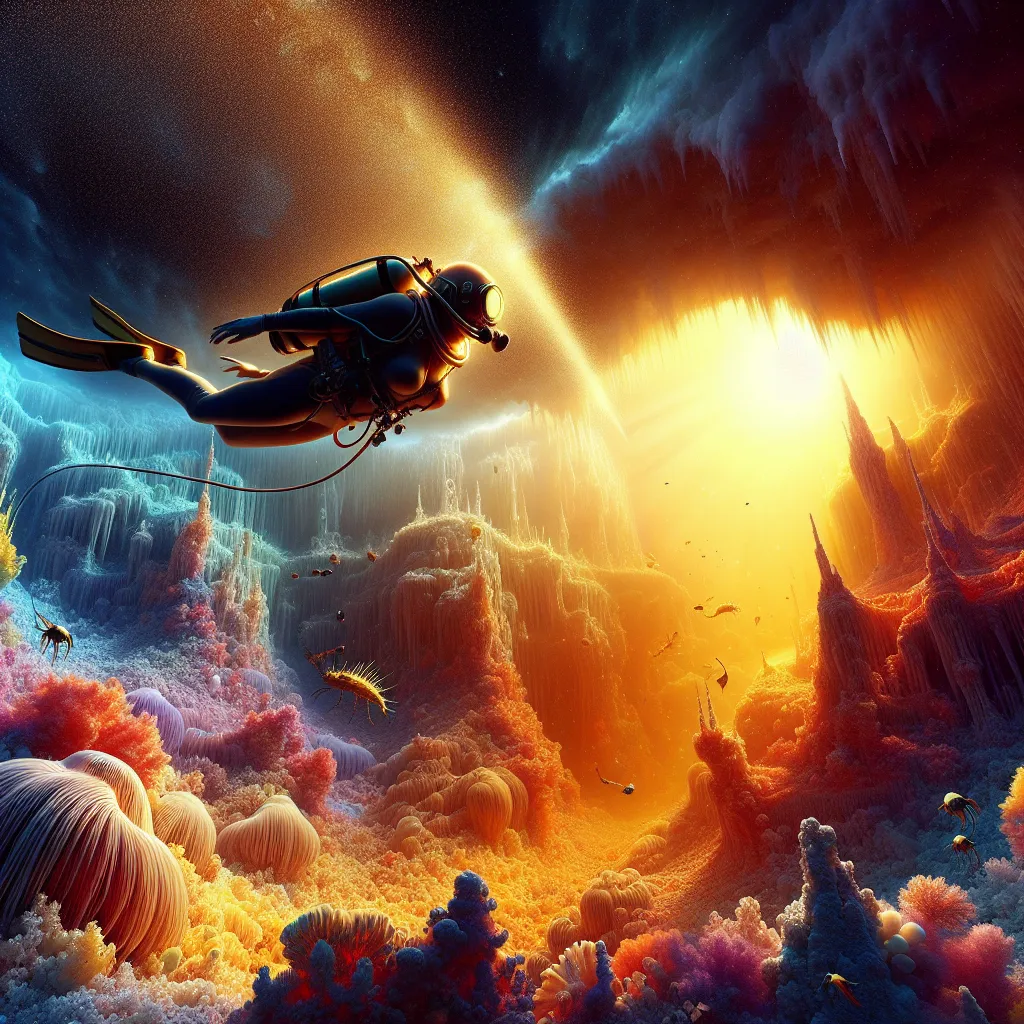
Imagine a diver making this journey—swimming from the sunlit surface down to the darkest trenches. First, they’d pass the continental shelf, a shallow region stretching out from the coast and rich with dramatic landscapes like the Monteray Canyon, as deep and vast as the Grand Canyon. Following the shelf, the diver would descend the continental slope where sunlight fades, temperatures drop, and water pressure intensifies. Here, the landscape is punctuated with strange craters and outcrops created by escaping gases.
Continuing the descent, the diver might encounter methane hydrates—underwater icicles trapping gas within their icy lattice. Methane hydrates hold vast amounts of natural gas, potentially more than all the world’s oil, gas, and coal reserves combined. This makes them an intriguing, though challenging, potential energy source for the future.
In the depths of the ocean, the landscape features surreal pools of dense brine that form underwater lakes. Surrounding these pools, life thrives in unlikely abundance, feeding off the gases that seep from the ocean floor. Creatures like tube worms flourish here, living for hundreds of years, proving that life can endure even in the most extreme environments.
Deeper still, one might find the mid-ocean ridge, a colossal volcanic feature stretching 40,000 miles across the globe. This undersea mountain range is where new oceanic crust is born. Hydrothermal vents along this ridge spew superheated, mineral-rich water, creating towering chimneys known as black smokers. These vents support unique ecosystems living without sunlight, with creatures deriving energy directly from the chemicals in their environment.
The journey continues to the abyssal plains, the vast flat expanses that cover much of the ocean floor, where pressures can crush almost anything. This is a resting place for everything that sinks—from marine snow (organic detritus) to the wrecks of ships and even the bodies of whales. Marine life here survives by relying on the steady rain of marine snow that settles over millennia.
On this journey through the ocean depths, one would also pass over the massive underwater mountains and volcanic islands like those of Hawaii, formed by the dynamic movement of the Earth’s plates over geological hotspots. As the sea floor travels across these hotspots, new islands form and old ones slowly erode and move towards subduction zones, where they are pulled beneath the Earth’s crust.
But the journey isn’t over. Descending further, the diver reaches the ocean trenches—the deepest and most dangerous parts of the ocean. These trenches are the site of immense geological activity and are responsible for some of the most powerful natural events on Earth, like the 2004 Indian Ocean tsunami caused by a massive 9.1 magnitude earthquake.
Exploring the ocean’s depths is more than just a scientific endeavor; it’s a journey into the unknown. From the pressures and darkness of the abyss to the strange phenomena of underwater lakes and the dynamic creation of new crust at mid-ocean ridges, there’s an entire world waiting to be discovered. Our understanding of what lies beneath the waves is still in its infancy, with only 10% of the ocean’s depths explored so far. Each dive reveals new species and processes, reminding us of the vast and mysterious world that lies below.