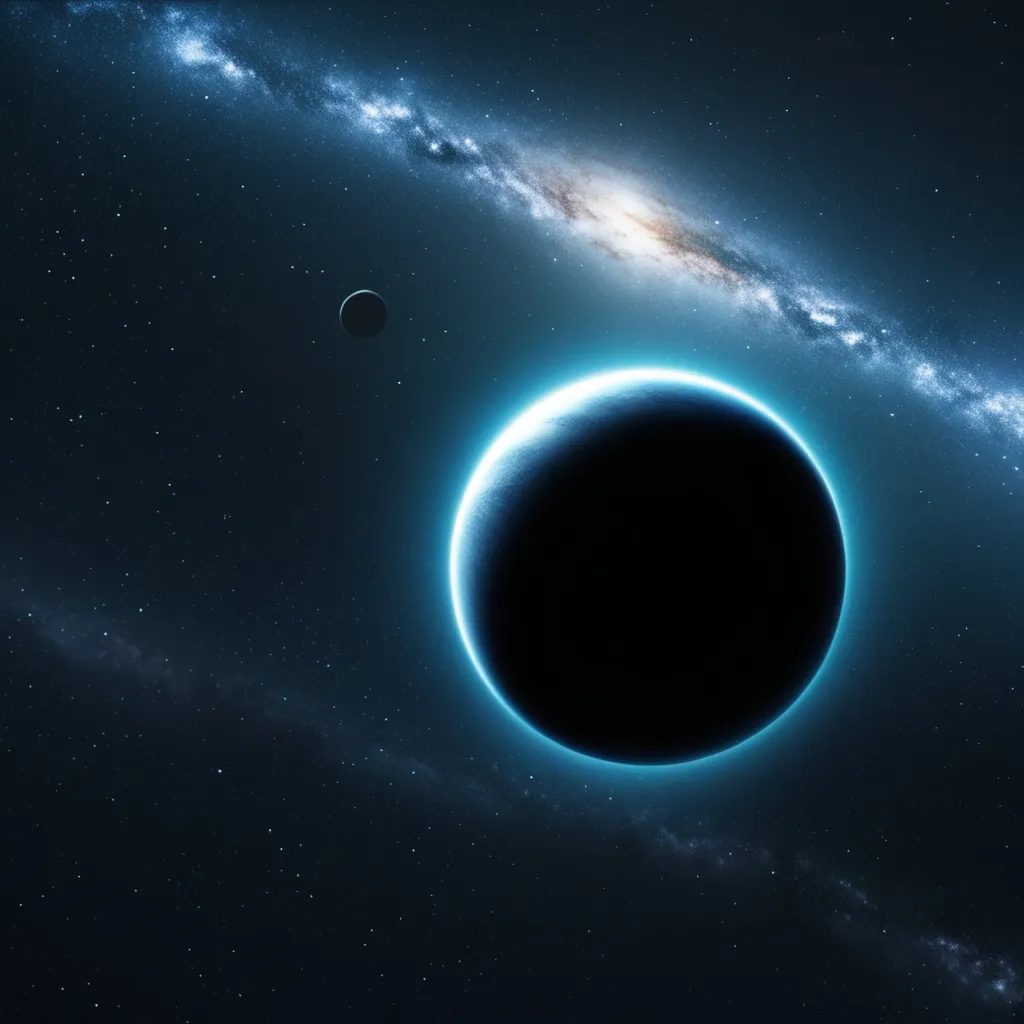
Cosmic Wanderers: The Fascinating World of Rogue Planets
Have you ever wondered about the mysterious objects floating through space, untethered to any star? These cosmic nomads, known as rogue planets, have captured the imagination of scientists and space enthusiasts alike. Let’s embark on a journey to explore these fascinating celestial bodies and uncover the secrets they hold.
Rogue planets, also called free-floating planets, are not as rare as you might think. In fact, our Milky Way galaxy is teeming with them. Scientists estimate that there are twice as many rogue planets as there are stars in our galaxy. That’s a whole lot of wandering worlds out there!
But how do these planets end up alone in the vast expanse of space? Well, it’s kind of like a cosmic game of musical chairs. Sometimes, planets form within a solar system but get kicked out due to gravitational shenanigans with other planets. Other times, they form all by themselves, outside of any planetary system. It’s a tough universe out there, and not every planet gets to stick around its home star.
Now, you might be wondering if these rogue planets pose any threat to our cozy little corner of the galaxy. While the idea of a massive planet hurtling towards Earth makes for great sci-fi movies, the reality is a bit less exciting (thankfully). The odds of a rogue planet entering our solar system in the next thousand years are about one in a billion. And the chances of it actually messing with Earth’s orbit? Even lower – about one in 2,000. So, we can probably sleep soundly at night without worrying about a planetary collision.
But let’s indulge our imagination for a moment. What if a rogue planet, say the size of Neptune or larger, did come barreling towards Earth? The results would be pretty catastrophic, to put it mildly. We’d first notice its effects through some serious gravitational disruptions. Think massive earthquakes, volcanic eruptions, and tsunamis on a scale we’ve never seen before. Our poor moon might even get torn apart by the rogue planet’s gravity, which would wreak havoc on our tides.
As this cosmic intruder got closer, things would get even wilder. If it had rings like Saturn, those rings would start interacting with our atmosphere. Picture a constant, global meteor shower, but way more intense. The sky would light up with what might look like a beautiful but deadly fireworks display as particles from the rings burned up in our atmosphere.
Cities around the world would face unprecedented disasters. Imagine Shanghai’s Huangpu River overflowing its banks, Los Angeles shaken by massive quakes, and Rome engulfed in volcanic eruptions. It would be a global catastrophe unlike anything in recorded history.
But before you start stocking up on canned goods and building a bunker, remember that this scenario is incredibly unlikely. It’s more of a thought experiment than a real threat. Still, it’s fascinating to consider the power and unpredictability of the universe we live in.
Speaking of unpredictability, have you heard of the Nibiru conspiracy? It’s a popular theory that claims a large planet called Nibiru (or Planet X) is on a collision course with Earth. According to the theory, this mysterious planet would cause all sorts of mayhem, including a physical pole shift and the destabilization of Earth’s magnetic core. But don’t worry – scientists have thoroughly debunked this theory. It doesn’t align with what we know about celestial mechanics, and there’s zero observable evidence to support it.
While rogue planets might seem scary, they could potentially play a surprising role in Earth’s far-future survival. In about 10 billion years, our Sun will turn into a red giant, swallowing up the inner planets. But some simulations suggest that a rogue star passing close to our solar system could potentially move Earth to a safer orbit. It’s a long shot, but it’s a reminder that even in the vastness of space, there might be unexpected cosmic interventions.
The study of rogue planets isn’t just about potential doomsday scenarios. It’s a window into the dynamic nature of our universe. These wandering worlds tell us stories about how solar systems form and evolve over billions of years. They challenge our understanding of planetary formation and make us question what defines a planet in the first place.
Rogue planets also spark our imagination about the potential for life in the universe. While it might seem unlikely for life to exist on a planet without a host star, some scientists speculate that certain rogue planets could potentially harbor life beneath icy surfaces, warmed by internal heat sources.
As our technology advances, we’re getting better at detecting and studying these elusive objects. Future space telescopes and missions might give us unprecedented views of rogue planets, helping us unravel their mysteries.
The existence of rogue planets reminds us of the vast scale and complexity of the cosmos. Our solar system, with its neatly ordered planets orbiting the Sun, is just one arrangement among countless others. The universe is full of chaos and wonder, with objects of all sizes roaming the galactic highways.
In many ways, rogue planets embody the spirit of exploration that drives astronomy and space science. They represent the unknown, the unexpected, and the potential for discovery. Every time we learn something new about these cosmic wanderers, we expand our understanding of the universe and our place in it.
So, the next time you look up at the night sky, remember that between those twinkling stars, there might be planets drifting silently through the darkness. They’re out there, invisible to our eyes but present in our scientific understanding and our imagination.
The story of rogue planets is ultimately a story about perspective. From the catastrophic scenarios we can imagine to the unlikely role they might play in Earth’s future, these wandering worlds remind us of the delicate balance that allows life to thrive on our planet. They make us appreciate the stability of our solar system and the protective embrace of our Sun.
As we continue to explore and understand the cosmos, rogue planets will undoubtedly play a starring role in our quest for knowledge. Who knows what secrets these cosmic nomads might reveal about the history and future of our universe? One thing’s for sure – the journey of discovery is far from over, and rogue planets are just one of the many fascinating chapters in the cosmic story we’re all a part of.