The Bloop Mystery: Cold War Submarine Secrets Hidden in Antarctica's Deepest Ocean Sounds
Discover the truth behind The Bloop - the mysterious 1997 ocean sound that defied explanation. Explore declassified evidence, military theories, and why this acoustic anomaly still puzzles scientists today.
The story begins with a mystery that refuses to fade, no matter how often it’s explained away. Picture this: in 1997, far out in the Pacific, I’m poring over raw data from a cluster of hydrophones, waiting for the usual daily hum—whales calling, ships grinding, maybe a distant quake. Then comes something new, something colossal. A sound ripples through the ocean, so loud and low that even hydrophones spaced over 5,000 kilometers apart register it. The team calls it “The Bloop.” At first, nobody can explain it. Its amplitude overshadows even the blue whale, the reigning heavyweight of living biological noise.
For months, the origin of this sound stirs debates. Initial theories bounce between monstrous sea creatures unknown to science and shifting plates in the planet’s icy southern reaches. Then, quietly, the U.S. National Oceanic and Atmospheric Administration releases a statement: it’s probably ice calving off Antarctica. That explanation should close the case. But does it? When you start digging into the details, the story opens up in unexpected places.
The first thing that struck me was just how far The Bloop traveled. These kinds of sounds—known as ultra-low-frequency signals—should fade quickly in the ocean, especially if they’re created by something as random as fracturing ice. But The Bloop doesn’t behave like natural seismic noise. Instead, it moves with a coherence and range that’s more textbook for engineered transmissions than for chaos in a frozen wilderness. The signal spreads faster and remains more focused than any icequake ever recorded. That’s where my curiosity spiraled: could ice really do this, or was something else at play?
Let’s pause and consider this: why would a signal like The Bloop move with such precision if it’s just the world’s loudest piece of ice breaking off? The best oceanographic models point to an artificial source—something incredibly powerful, harnessing the way sound travels in seawater, a trick military engineers have spent decades perfecting.
Then there’s the matter of frequency. Ice calving events, according to every database and field experiment I can find, produce broad-spectrum noise—a sort of rumbling roar. But The Bloop? Its main punch exists below 100 Hz, exactly in the sweet spot that militaries favor for covert, long-distance communications. If you want to send a signal across an entire ocean without being picked up by casual listeners, you use frequencies just like these. But here’s the kicker: the signal’s spectrum lacks the messy overtones and harmonics that come from something as jagged as a glacier shattering. Instead, it’s clear, focused, and tuned.
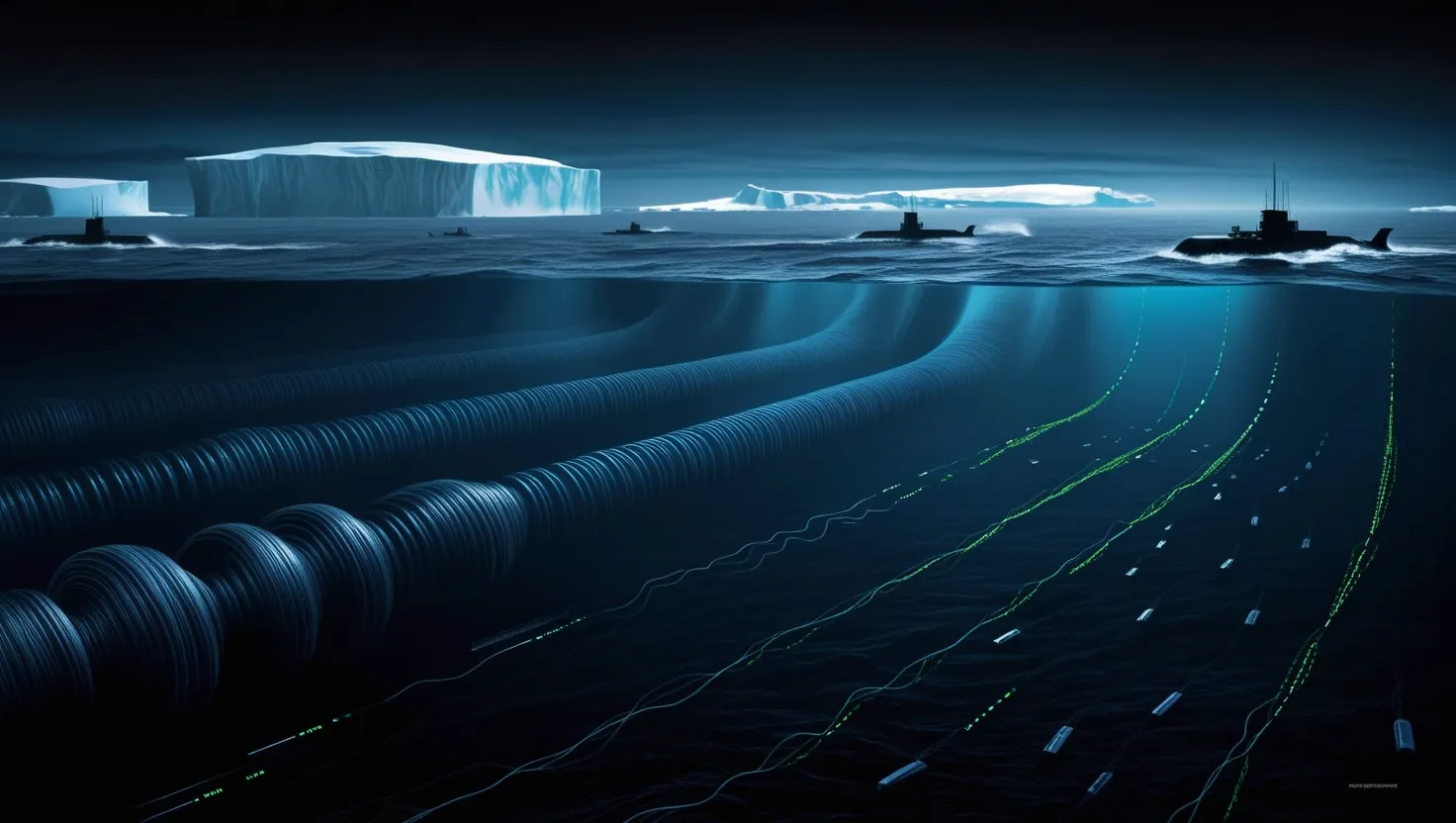
All this technical wizardry points me somewhere unexpected: to the shadowy world of submarine espionage and signal testing beneath the waves. During the Cold War, the U.S. and Soviet navies played a cat-and-mouse game not just on the surface, but across the entire ocean basin. Undersea cables, secret listening posts, and scattered arrays of hydrophones created a vast surveillance architecture—most of which the public never heard about. Enter Project ARTEMIS, an obscure initiative that, in declassified fragments, describes the development of super-powerful low-frequency transmitters to track submarines across continents.
The coincidences start piling up. The supposed “source” of The Bloop—somewhere around 50°S 100°W—just happens to intersect known Soviet sub routes and, according to naval records released years later, was a test site for classified U.S. surveillance systems. Did someone push the wrong button during a prototype run? Or did a secret transmitter, buried for decades, fail spectacularly and spill its signal across the world’s oceans?
Yet there’s more. “The sea, once it casts its spell, holds one in its net of wonder forever,” Jacques Cousteau once remarked. When NOAA’s best analysts try to recreate The Bloop using every known ice event—a painstaking process involving thousands of hours of sensor data—nothing quite matches. Simulated icequake sounds lack the coherence and punch. No real-world event since 1997, even with superior monitoring, has ever duplicated The Bloop’s acoustic fingerprint. Whatever happened, it was unique.
Here’s a question: if this was a natural event, why can’t we repeat it? Oceans are littered with ice, and Antarctic calving happens all the time. Are we missing something fundamental about how nature works, or is the truth simply classified?
I find myself revisiting the oddities in declassified budgets. Project ARTEMIS, officially mothballed in the mid-1970s, keeps drawing funding—sometimes under different line items, sometimes buried in unrelated naval research—up until the year The Bloop is detected. The pattern is familiar to anyone who’s tracked military black projects: when money flows long after a program ends, it usually means the game continues under a different name, or with new technology.
There’s a darker theory lurking on the edges, whispered in defense journals and behind closed doors. Maybe The Bloop wasn’t a test signal but an accident—a submarine disaster of a kind never publicly acknowledged. The Western Pacific and Southern Oceans were favorite haunts for Soviet and NATO submarines armed with advanced propulsion, some of which reportedly used experimental energy sources. What if one failed catastrophically? A hull implosion or an energy system meltdown could feasibly release enough energy to produce a sound like The Bloop. The lack of any corroborating seismic data fits with a disaster so deep and so isolated that no satellite or seismograph could pick it up.
Mark Twain once wrote, “Truth is stranger than fiction, but it is because Fiction is obliged to stick to possibilities; Truth isn’t.” That fits perfectly here. The Bloop’s story illustrates just how many layers oceanic mysteries can hide. The public face of Cold War naval research is only the tip of a much larger iceberg, and the oceans, for all our technology, remain stubbornly inscrutable.
I sometimes imagine the technicians in 1997, headphones on, realizing they’re hearing something no one has ever heard before. Did they grasp the weight of the moment, or did they assume—like so many before—that science could deliver a neat answer? Today, with all the data at our fingertips, we’re still left with more questions than conclusions. Why does the most powerful undersea sound ever recorded fit so neatly into the plans of classified surveillance? What else is hidden beneath the waves, waiting for a chance signal or a stray anomaly to reveal itself?
Perhaps the reason The Bloop endures as a legend is its refusal to conform—neither monster nor mundane, neither fully explained nor truly resolved. In a world obsessed with explanation, it stands as a rare reminder: some secrets are too big, too strange, or too well-guarded to surrender quietly.
“The important thing is not to stop questioning. Curiosity has its own reason for existing,” said Albert Einstein. I keep that in mind whenever a new theory about The Bloop surfaces. Maybe someday, a declassified file or a new ocean sensor will crack the code. Until then, the ocean keeps its secrets. And so, The Bloop echoes on, a cold war footnote echoing through the depths, daring us to listen a little closer.
What sound will we hear next, I wonder, and will we be ready to believe what the data is really telling us?