5 Strange Planetary Mysteries That Challenge Everything Scientists Thought They Knew About Space
Discover 5 mind-bending planetary mysteries that challenge everything we know about our solar system, from Saturn's hexagonal storm to Venus' backwards rotation.
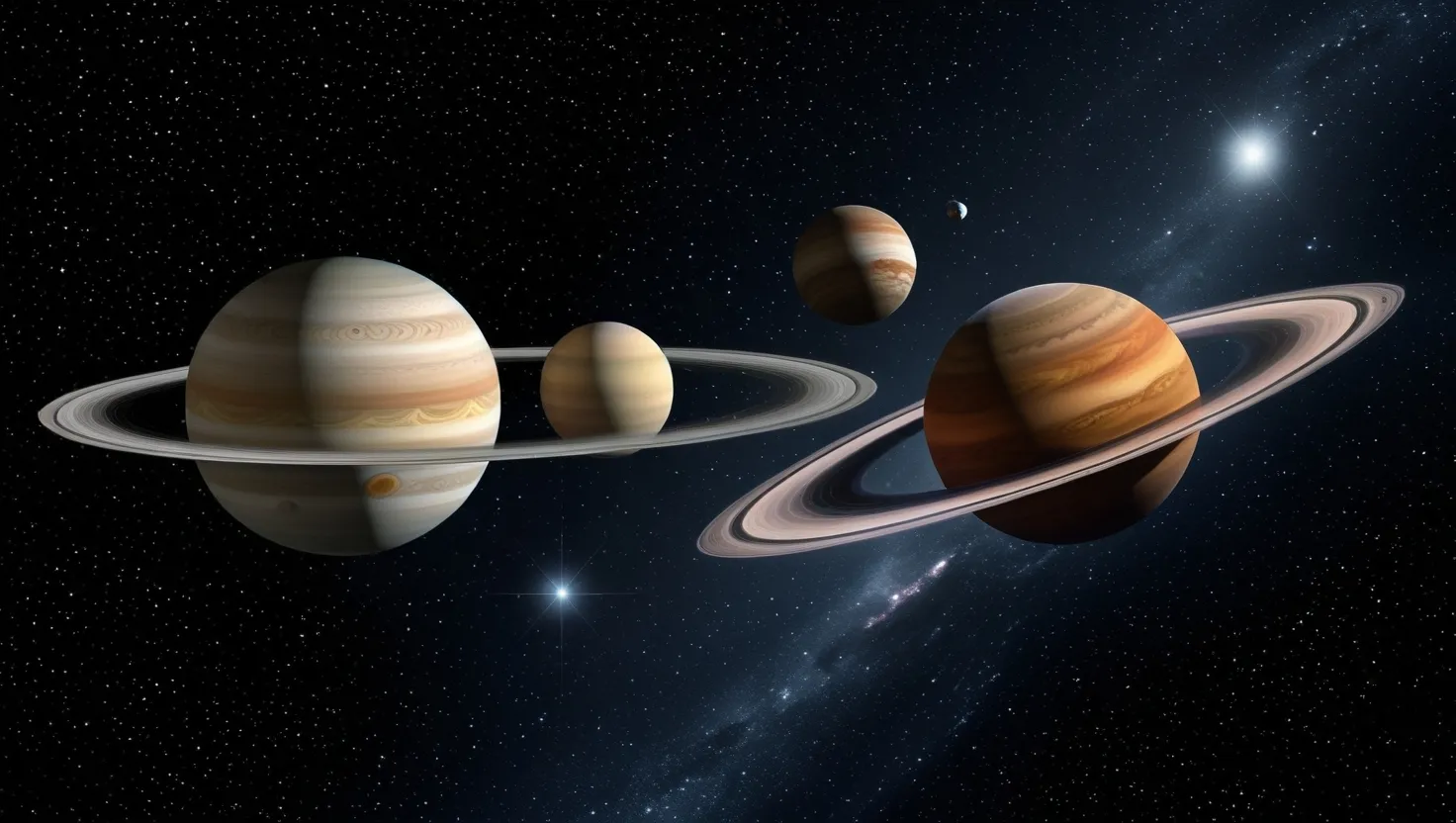
Planetary mysteries remind me that for every certainty science gives me, there are just as many open questions. When I look at our solar system, I see a collection of worlds that are far stranger than textbook diagrams suggest. If I follow mainstream models, I’d expect planets to behave a certain way—weather, orbits, rotations, and geology all fitting into neat trends. Yet reality insists on throwing curveballs, the kind that force astronomers back to the drawing board and invite me to wonder what I might be missing.
Let me start at Saturn’s north pole, where one of the cosmos’ most mesmerizing weather patterns continues to baffle experts—a six-sided, persistent jet stream, known as the hexagonal storm. No one predicted something so geometric could emerge in the churning, chaotic atmosphere of a gas giant. It’s 20,000 miles wide, its straight sides roughly the width of Earth. Scientists have created similar shapes in fluids under lab conditions, but seeing it persist so perfectly, for years on end, is something I find almost uncanny. What could stabilize such a sharp pattern in Saturn’s overwhelmingly dynamic winds? Why do none of the other gas giants display anything quite like it? Even the word “unique” feels too weak. Imagine peering down at Saturn’s pole and seeing not swirls, but a planet-sized hexagon staring straight back at you. Doesn’t that make you wonder what else I simply don’t expect out there?
Now, if you think weird weather is strange, wait till you hear about Venus. A day on Venus—one full rotation—takes 243 Earth days. Yet its year, a full trip around the Sun, takes only 225 days. That means a day on Venus is longer than its year. And, Venus spins in the opposite direction compared to most other planets. If you could stand on its baked surface, the Sun would rise in the west and set in the east. Venus’ rotation is called retrograde, which is rare in our solar system—and the real kicker is, no one is sure what could flip an entire planet’s spin like this. Was it a cosmic collision so violent that it reversed Venus in its tracks millions or billions of years ago? Or did some tide of gravitational forces with the Sun gradually grind Venus’ rotation to a halt, then start it spinning backward? These questions tease me with the notion that planetary dynamics have wild cards, and that the universe is less clockwork and more jazz improvisation.
“Somewhere, something incredible is waiting to be known.” – Carl Sagan
Jupiter is no stranger to storms, but its Great Red Spot is the icon of planetary mysteries. This swirling behemoth is big enough to swallow the Earth whole—twice over, in fact. I know it’s raged for centuries, its presence noted in sketches dating back to the 1600s. I see a colossal anticyclone, spinning in the opposite direction to storms on Earth, powered by forces I barely grasp. Even today with our probes and telescopes, we’re still puzzling over its bright color, its incredible depth (it extends more than 200 miles down from the clouds), and its shrinking outline. Why does a storm persist for centuries on a world with no solid ground? Recent research hints it could be “feeding” on smaller storms, drawing their energy as they merge and disappear. But that’s still just an idea; the spot’s shrinking and changing in ways that don’t match our models. Is this storm winding down? Does it suggest there’s a rhythm to planetary weather cycles that I simply haven’t seen play out on Earth’s shorter timescale?
Have you ever wondered why, with hundreds of billions of stars and probably trillions of planets in the galaxy, we have yet to find a single sign of life beyond Earth? That’s the riddle wrapped in the Fermi Paradox. Our models predict habitable zones, exoplanets, and even organic molecules drifting through space. But all those expectations clash with the silence that greets our every attempt at contact. Is it possible advanced civilizations inevitably destroy themselves? Does intelligent life self-destruct, or are geological catastrophes simply a universal hazard? Or, maybe life is so rare, or so different from our assumptions, that our instruments simply miss it? This question often feels less like physics and more like philosophy: What circumstances have brought us here, with minds that can ask these questions, yet ears that hear nothing in response? Are we truly alone, or merely isolated by the scale and strangeness of the universe?
“Not only is the Universe stranger than we think, it is stranger than we can think.” – Werner Heisenberg
Let’s head now to the frozen frontier, where little Pluto—demoted from planet, but never from fascination—offers one of the most active surfaces in the solar system. It’s heart-shaped glacier, made of nitrogen ice, acts not like a frozen wasteland but as a living conveyor belt. This ice pulses and flows, creating strange troughs and polygons across the landscape. Why is such a small, distant world so geologically active? The heat needed for this movement remains an open question. Is it leftover warmth from Pluto’s ancient formation, radioactive decay deep inside, or some kind of chemical or mechanical process we simply haven’t imagined? Whatever drives it, Pluto contradicts the assumption that small, cold worlds should quickly freeze into silence. Instead, I see activity, churn, and surface renewal echoing, in miniature, the restless forces of much larger planets.
All this leads me to a bigger realization: planetary science is much less about certainty than about surprise. My models keep improving, adjusting for new data, but these five mysteries hide lessons about the limits of knowledge. Sometimes, our theories hold up. Often, though, it’s the oddities—the hexagons, the backwards-rotating planets, the ancient storms, and the silent skies—that teach me the most. They reveal that nature can be precise, creative, and wildly unpredictable. In every mystery, the cosmos seems to be inviting a new question, tempting another generation to look, to measure, and to rethink what I thought I knew.
What if Saturn’s hexagon is only the first of many geometric surprises to appear elsewhere? Could another planet, perhaps beyond our solar system, spin backwards in a completely different way—or even have multiple conflicting rotations? If Jupiter’s storms live for centuries, what could persist for millennia further out, in unknown weather systems? And could Pluto’s moving glacier be a hint that even smaller worlds, perhaps moons or asteroids, have hidden processes awaiting discovery?
“The most beautiful thing we can experience is the mysterious. It is the source of all true art and all science.” – Albert Einstein
Sometimes I think the greatest value in these mysteries is not just the answers—or even the hunt for them—but the humility they give me. Our solar system is no static diagram. It’s a place where storms last centuries, where ice on a dwarf planet pulses with energy, where a year can be shorter than a day, and where silence out in the cosmos raises as many questions as the planets themselves inspire. Every unanswered question is a reminder that exploration means accepting the unexpected, and that sometimes, the universe is stranger—and more wondrous—than any model I could ever hope to build.
So, what questions will you ask next? And more importantly, what will you do when the universe answers with something you never saw coming?