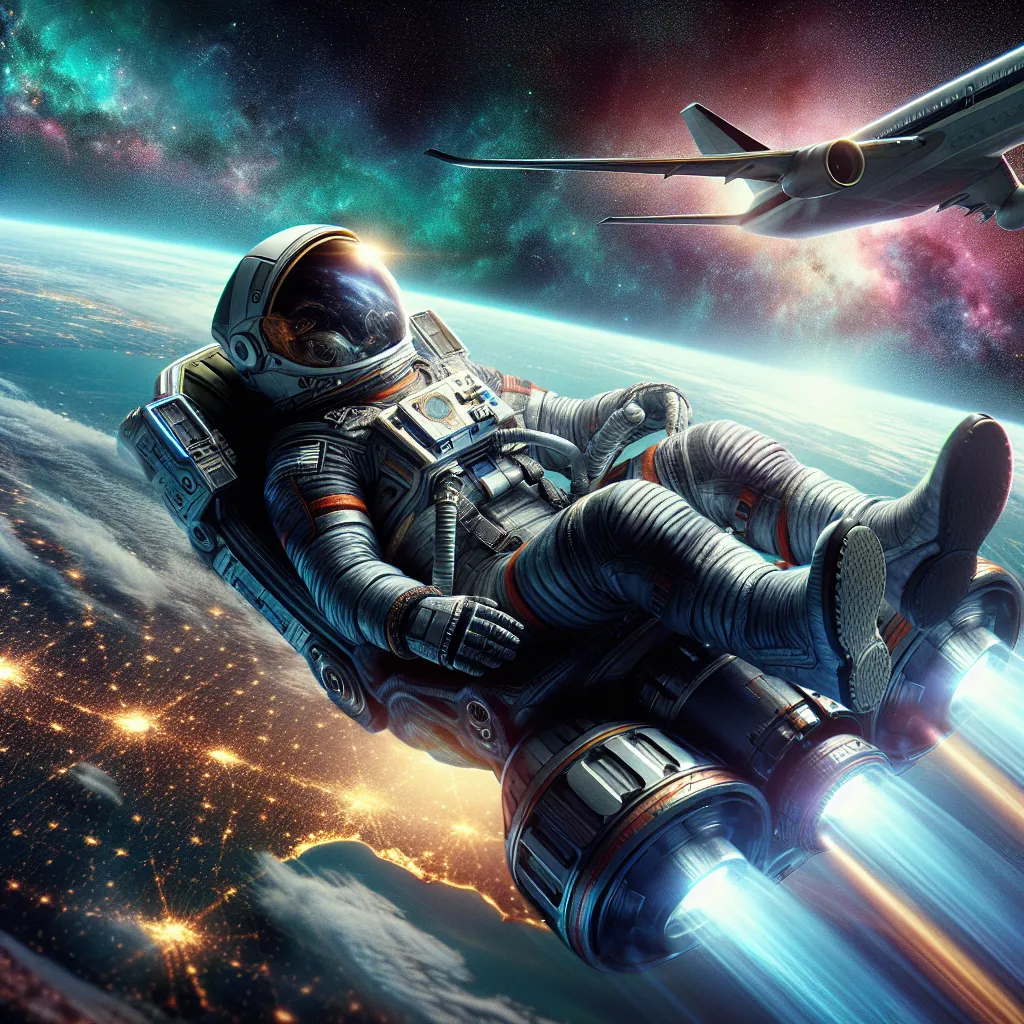
Hey there, I’m Nigel, and welcome to “Nigel Goes to Space!” As an astronaut heading to space with Virgin Galactic, I’ve got some cool insights to share about how we get to space and back.
Let’s talk about gravity first. Gravity is what keeps us grounded here on Earth. If you drop an apple, gravity pulls it down. To get into space, we need to fight this force. That’s where rockets come in. While airplanes use air pressure to climb high, rockets are necessary for space travel because they work in the vacuum of space, beyond Earth’s atmosphere.
Our journey with Virgin Galactic starts with a plane that carries our rocket up to a certain altitude. Then, the rocket ignites and propels us further, battling gravity to reach space. We’ll be doing a suborbital hop, which means we’ll go up and then come right back down, just like throwing an apple into the air and catching it. This trip offers a few exhilarating minutes in space.
Now, if we wanted to stay in orbit around Earth like the International Space Station (ISS), we’d need to travel much faster, up to 28,000 kilometers per hour. That’s around 17,700 miles per hour. Space tourists can experience orbit too, with a hefty price tag, thanks to the powerful rockets that can take them there.
Even in orbit, gravity doesn’t disappear. The ISS is constantly being pulled down by Earth’s gravity, but its incredible speed means it keeps missing the Earth, making it circle around instead of falling back.
To break free of Earth’s gravity entirely, you’d need to hit escape velocity, which is around 40,000 kilometers per hour, or approximately 25,000 miles per hour. That’s what the Apollo astronauts achieved with the mighty Saturn V rocket to get to the Moon. But even then, you’re still under the Sun’s gravitational pull, which controls every planet in our solar system.
Coming back to Earth involves slowing down from those dizzying speeds. Gravity will bring us back, but re-entering the atmosphere requires careful handling. When Apollo astronauts returned, their blunt capsule design helped slow them down and allowed for a parachute landing. The Space Shuttle, on the other hand, had wings and relied on heat shields and controlled maneuvers to land on a runway. Our descent will be slower, so we won’t heat up as much. We’ll feel some G-forces, like being pushed into our seats, but we’ll safely land back at Spaceport in New Mexico.
So, that’s the scoop on getting to space and back. Stay tuned on “Nigel Goes to Space” for more adventures and insights.