Neptune is a wild place. Picture winds faster than any storm on Earth, with speeds reaching up to 1,200 miles per hour. Those fluffy white clouds moving at breakneck speed really paint a picture of a tumultuous world. Yet, as humans dream of exploring new homes, Neptune is off the list. Its extreme environment makes it impossible for us to visit.
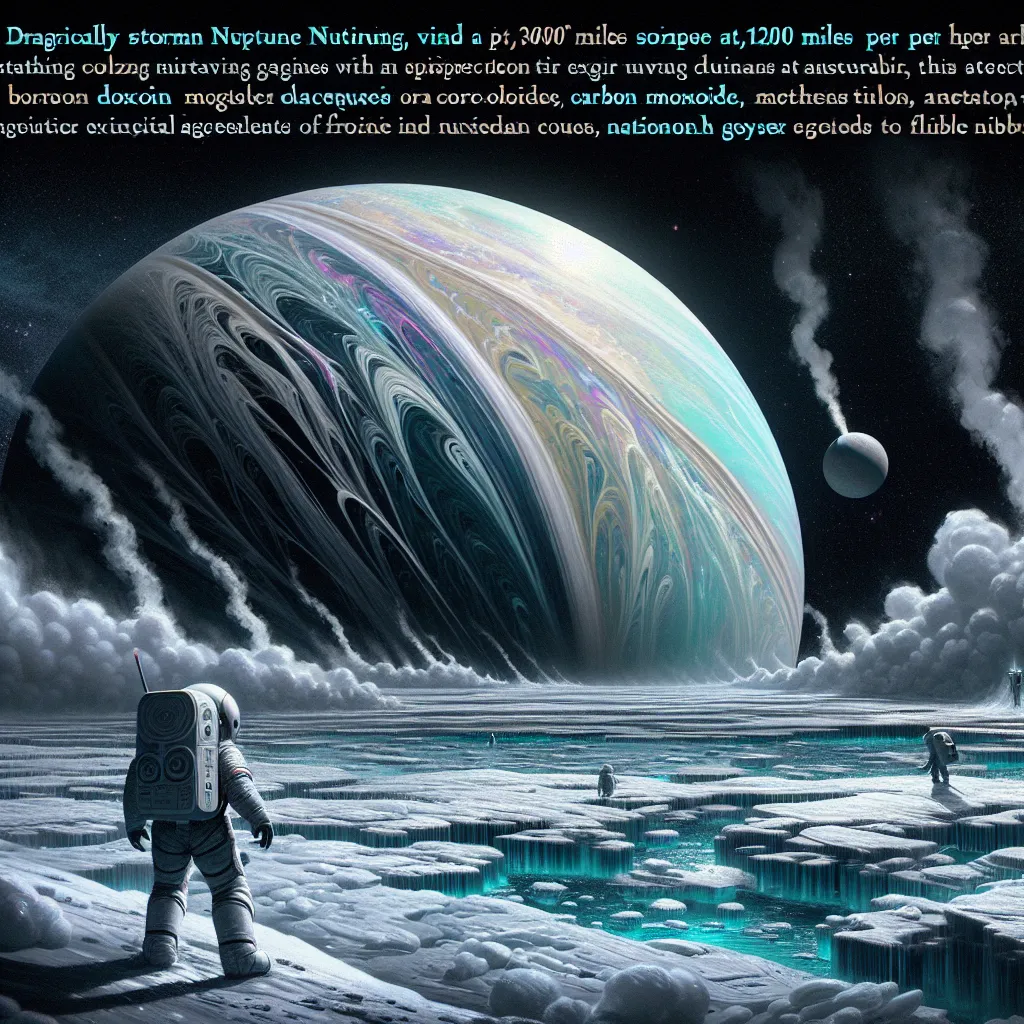
But what about Neptune’s moons? Take Triton, for instance. While it’s also freezing, it’s a solid surface and might be large enough for us. Dr. John Spencer from the Southwest Research Institute in Colorado has been studying Triton’s intense climate. Up close, Triton is covered in a bizarre mix of frozen gases, from carbon dioxide and carbon monoxide to methane, all blanketed by frozen nitrogen. Imagine walking through snow drifts made of these elements, with temperatures plunging to -390°F.
Dr. Spencer, along with assistant Eddie Goldstein, uses liquid nitrogen to mimic Triton’s conditions. The crux of their experiment is finding materials that stay flexible in such a harsh environment. On Earth, rubber is our go-to for flexible, airtight seals on spacesuits. But at Triton’s temperatures, rubber turns brittle and shatters easily.
The secret might lie in everyday materials like nylon. Nylon remains flexible even when frozen, thanks to its weave. Each tiny thread, as thin as human hair, helps the material stay pliable. So, future spacesuits might use mundane but cleverly treated materials to handle Triton’s chill.
Even if we overcome these challenges, Triton isn’t without other dangers. Under its surface lurk oceans of liquid nitrogen. When the sun warms the moon, this nitrogen forms pressurized gas, which then erupts as geysers. These geysers can blast moon dust miles into the air, leaving dark streaks across the landscape. Dr. Spencer’s lab recreates this spectacle, demonstrating how pressure can turn trapped nitrogen into powerful jets.
So, while Triton is fascinating, it’s not a place we could easily call home. The search for a new home within our solar system seems to end here. The further we go from the sun, the colder and more barren it gets. Beyond Neptune lie only small, icy worlds like Pluto. But who knows what lies in the unknown? Out there, the possibilities are endless, and maybe one day, we’ll find a place that’s just right for us.